(Image: Jared Rodriguez / t r u t h o u t; Adapted: Tech. Sgt. Molly Dzitko / U.S. Army, Master Sgt. Andy Dunaway / U.S. Army)
International lawyers and activists converged at a conference titled
The Iraq Commission, in Brussels, Belgium, April 16 and 17, with the
primary aim of bringing to justice government officials who are guilty
of war crimes in Iraq.
“Within a few days of this, a lawless atmosphere developed within my
unit,” Ross Caputi, a former marine who took part in the brutal November
2004 siege of Fallujah told the Iraq Commission. “There was a lot of
looting going on. I saw people searching the pockets of the dead
resistance fighters for money. Some people were mutilating corpses.”
The conference represents the most powerful and most current
organized attempt in the world to bring justice to those responsible for
the catastrophe in Iraq, and included powerful international lawyers
like International Court of Justice lawyer Curtis Doebbler and Louie
Roberto Zamora Bolanos, a lawyer from Costa Rica who successfully sued
the government of his country for supporting the war in Iraq.
Their goal for the conference was to begin taking concrete steps
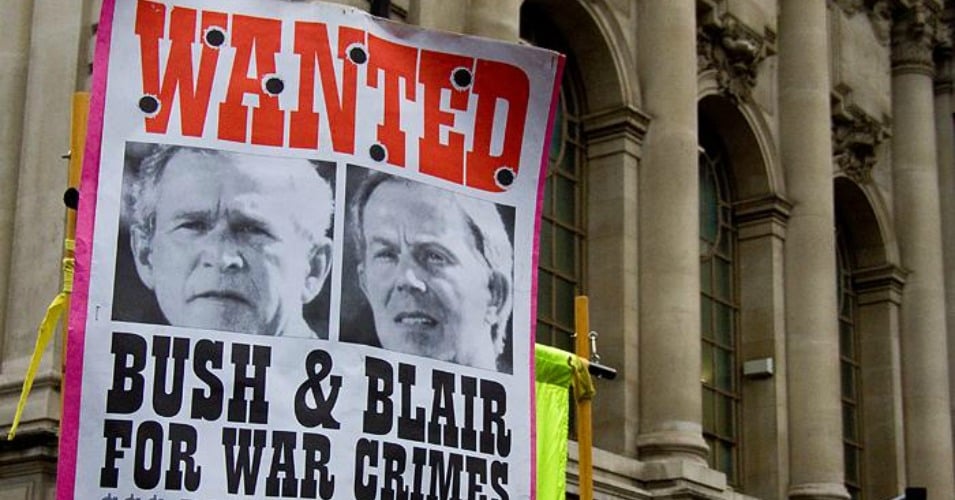
toward international lawsuits that will bring former UK Prime Minister
Tony Blair and former US President George W. Bush, along with those
responsible in their administrations, to justice for the myriad war
crimes committed in Iraq.
“I was very misinformed and uninformed about the goals of our
mission, about who our enemy was and about the danger that we posed to
civilians,” Caputi said of the context for his actions. “My command told
us that all civilians had left Fallujah and that the only people who
remained in the city were combatants. This was not true, though. The Red
Cross estimated that up to 50,000 civilians remained trapped in the
city. But nobody in my unit knew that.”
“Now is a time for us to close the net on the war criminals,” Dirk
Adriaensens, a long-time Iraq activist who cofounded the conference,
told Truthout. “If we don’t do that, the fish will get away. But if this
is only a legalistic thing, without the activism, it won’t work because
people won’t know that it is happening.”
Adriaensens is aiming to generate one massive lawsuit that condemns
former (and current) members of the US and UK governments for war
crimes, crimes against humanity and crimes against peace for their roles
in the Iraq invasion and occupation.
“The conclusions of such a court case would lead to reparations being
paid to the state and people of Iraq,” added Adriaensens, who is also a
member of the executive committee of the Brussels Tribunal. The
tribunal is an international network of intellectuals, artists and
activists who denounce and organize against the logic of permanent war
promoted by the US government that is currently targeting the Middle
East. “We’re here to condemn the original sin: the illegal invasion and
occupation of Iraq and how we can bring the perpetrators to court.”
While several people’s tribunals, citizens arrests, and other forms
of ongoing activism around Iraq have been helpful and necessary in the
absence of the implementation of international law, they have not been
enough, the conference organizers believe.
“Legal action is essential and can take many forms: universal
jurisdiction, defending Iraqi victims in court, seeking arrest warrants
when former US politicians want to travel outside the US,” Adriaensens
said.
The “other measures” he references are reparations for the millions
of Iraqis who have suffered from the invasion and occupation of their
country, as well as former government officials like Bush and Blair
spending the remainder of their lives in jail.
International Context
The conference was held at Vrijie University in Brussels, and
coincided with the 18th Congress of the International Association of
Democratic Lawyers (IADL), where hundreds of lawyers from more than 60
countries gathered in the same venue, with many attending the Iraq
Commission.

Dirk
Adrieaensens, with the Brussels Tribunal, organized the conference, and
has been an Iraq human rights activist for more than two decades.
(Photo: Dahr Jamail)
“March 20 marked the 11th anniversary of the US invasion of Iraq, a
brutal act of aggression that will be remembered as one of history’s
worst crimes,” Sabah al-Mukhtar, chairman of the Iraq Commission and
president of the Arab Lawyers Association said during his opening
remarks for the conference. “The first decade of the 21st century will
probably be viewed as the decade when rules of international law were
brought into disrepute like no other time.”
Al-Mukhtar stated that the UN was used “illegally and unethically” to
destroy Iraq, a country that was a founding member of the UN.
“Aside from the Abu Ghraib catastrophe; the gang rape and killing of
the teenage girl Abeer al-Janabi and her family in Yusufiyah; aside from
the targeted killings of academics, media professionals and ethnic or
religious minorities, the legacy is more than 4 million Iraqi refugees,
more than 3 million orphans and more than a million widows,” he stated
to the audience.
While the United States is not a member of the International Criminal
Court, former president George W. Bush, along with several members of
his cabinet including Donald Rumsfeld, Colin Powell and Condoleeza Rice,
to name but a few, are guilty of war crimes for their roles in creating
the conditions for the invasion and occupation of Iraq, according to
lawyers at the conference.
“Lest current events cloud principles, and in order to restore focus
on the rules of international rules, such as state responsibility, human
rights, war crimes, crimes against humanity, there will be no justice
for the victims of this crime against peace,” Al-Mukhtar stated, in
concluding his opening remarks. “We will discuss practical approaches to
ensure accountability and put an end to impunity.”
Tun Mahatir Muhammad, the fourth prime minister of Malaysia (and also
the longest-serving prime minister of the country), backs the Kuala
Lumpur Initiative to Criminalize War, which aims to make all acts of war
illegal. Mahatir provided the conference a video message for the
occasion.
“We must criminalize war because we consider the killing of one
person by another as murder, and we are even prepared to punish him by
taking his life,” Mohammed said. “But if you kill a million people in
war, it is glorified, and the killers are given medals and statues and
honored. There is a contradiction here, and it is time that killing be
made a crime, whether it be in peace or in war. And if it is a crime,
whoever starts an aggressive war should be considered a criminal and
tried in a court of law. That is why our tribunal has tried Mr. Bush and
Mr. Blair and found them both guilty as war criminals.”
Muhammad added that their tribunals in Malaysia that reached guilty
verdicts on Bush and Blair are valid, because even during the Nuremburg
trials, when the prosecutions were unable to find the offender, he was
still tried en absentia.
Adrieaensens told Truthout that the war against Iraq “was not just
immoral, it was properly illegal and fits the Nuremberg definition of a
crime against peace. Such a war should have its legal consequences for
the aggressors and rights for the victims under international law.”

Sabah al-Mukhtar is the president of the Arab Lawyers Association and chair of the Iraq Commission. (Photo: Dahr Jamail)
Nevertheless, to date, no government official from any country that
were members of the so-called “coalition of the willing” have been
brought to justice for war crimes, crimes against humanity or for waging
a war of aggression, which is the supreme international crime.
“We have to change that equation,” Adrieaensens said. “All those who
are responsible for the invasion of Iraq should be held accountable for
the destruction of the country’s infrastructure, its economic and social
structures, its historical past and its health and education.
Reasonable legal experts should work towards the goal of making
reparation with the Iraqi people who have been so deeply affected by
this war and its aftermath, and they should bring the perpetrators to
justice.”
His group, the Brussels Tribunal, brought together international
legal experts to explore possibilities for legal actions against those
responsible for the war against Iraq, in hopes that the conference might
serve as a working meeting to generate concrete results for future
prosecutions.
Michel Chossudovsky, a professor of economics at the University of
Ottawa and an author and adviser to governments of developing countries,
spoke of what he believes is a “world crisis” caused primarily by the
United States’ “long war,” which “threatens the future of humanity.”
“This ‘war without borders’ is being carried out at the crossroads of
the most serious economic crisis in world history, which has been
conducive to the impoverishment of large sectors of the world
population,” he said. “The Pentagon’s global military design is one of
world conquest. The killing of civilians is part of that agenda. The US
agenda in the Middle East is to change countries into territories, this
is the basis of destabilizing country after country across the world,
and instituting PAX Americana.”
Chossudovsky believes that US worldwide militarization is part of a
global economic agenda, and the invasion of Iraq was but one component
of this agenda.
Prior Attempts to Attain Justice
Several attempts have been made to bring the responsible parties to court. A few examples include:
• 2005: The Association of Humanitarian Lawyers filed a petition at
Organization of American States (OAS) against the United States for
attacks on hospitals and clinics in Fallujah.
• September 2005: German court declared that the Iraq war violated international law.
• November 2006: Center of Constitutional Rights (CCR) filed a war crimes complaint against Donald Rumsfeld in Germany.
• March 2007: Spanish judge called for the architects of the Iraq invasion to be tried for war crimes.
• October 2007: International Federation of Human Rights Leagues
(FIDH) and CCR have filed a lawsuit in France alleging that former US
defense secretary Donald Rumsfeld allowed torture at US-run detention
centers in Iraq and Guantanamo Bay.
• November 2011: In Kuala Lumpur, after two years of investigation by
the Kuala Lumpur War Crimes Commission (KLWCC), a tribunal (the Kuala
Lumpur War Crimes Tribunal, or KLWCT), consisting of five judges with
judicial and academic backgrounds, reached a unanimous verdict that
found George W. Bush and Tony Blair guilty of crimes against peace,
crimes against humanity and genocide as a result of their roles in the
Iraq War.
While it is clear that the International Criminal Court is not being
used appropriately to bring justice to those responsible for the
disaster in Iraq, there have been several hopeful signs.
• The Chilcot Inquiry, an open inquiry investigating the government
of Tony Blair for its role in the invasion and occupation of Iraq,
should generate its conclusions, hopefully very soon.
• In January 2014 a devastating 250-page dossier, detailing
allegations of beatings, electrocution, mock executions and sexual
assault, was presented to the International Criminal Court (ICC) and
could result in some of Britain’s leading defense figures facing
prosecution for “systematic” war crimes. This formal complaint to the
ICC is the culmination of several years’ work by Public Interest Lawyers
(PIL) and the European Centre for Constitutional and Human Rights
(ECCHR). It calls for an investigation into the alleged war crimes,
under Article 15 of the Rome Statute.
• In 2013, American lawyer Inder Comar, who is representing Sundus
Shaker Saleh, an Iraqi single mother who is now a refugee in Jordan, as
plaintiff against officials in the former administration of former
president George W. Bush, filed a class action lawsuit
Saleh v. Bush.
The primary complaint revolves around the international precedent that
all violent actions by sovereign nations must either be performed in
self-defense or with approval of the United Nations Security Council,
specifically “no act of aggression.”
“Justice has to prevail, for the sake of our children, for the Iraqi
people and for the sake of the future of mankind,” Adrieaensens said.
“No justice, no peace. During this commission we will not address the
current situation in Iraq. We’re here to condemn the original sin: the
illegal invasion and occupation of Iraq and how we can bring the
perpetrators to court.”
Crimes Committed in Iraq Since 1991
The first session of the conference highlighted war crimes that have
been committed in Iraq since the 1991 Gulf War, but also included the US
occupation.
Ross Caputi spoke at length about the war crimes and atrocities he
witnessed during the November 2004 US military siege of Fallujah.

Ross
Caputi served in the US military, from 2003 to 2006, and participated
in the massive military siege of Fallujah in November 2004. (Photo: Dahr
Jamail)
He went on to explain that he and his fellow soldiers were not told
that US military personnel, who were manning the checkpoints that
surrounded Fallujah, were not allowing any “military-aged males” to flee
the city, despite a lack of evidence proving they may have been
resistance fighters.
“This contributed to the indiscriminate nature of the operation,”
Caputi said, of the siege that, according to the Iraqi Fallujah-based
human rights and environmental NGO Conservation Center of Environmental
and Reserves in Fallujah, resulted in approximately 5,000 residents
being killed, at least 60 percent of them civilians.
“We called in airstrikes and used tanks and bulldozers in residential
neighborhoods,” Caputi told a silent audience populated by many Iraqis.
“There could have been civilians trying to hide out in their homes, but
we never took any precautions to make sure there wasn’t. We simply
fired wherever we thought there were combatants.”
Caputi told of a tactic used called “reconnaissance by fire,” which
is, as he explained, “when you fire somewhere, into a building for
example, to see if any combatants are there. This tactic is obviously
indiscriminate, but we never even considered the possibility that there
might be civilians in these houses that we were firing into.”
“I even saw a unit bulldozing an entire neighborhood, one house after
another without checking to see if anyone was inside,” Caputi, who has
since founded the
Justice for Fallujah project, added.
Caputi went on to tell of the use of the restricted weapon white
phosphorous in civilian areas, as well as another incident: “When a
10-year-old boy was bunkered inside a house with two resistance
fighters. We demolished the house on top of all three of them.”
He concluded his remarks by telling the audience his life since that
time has been about “finding and facing the truth” and working to make
amends to the people of Fallujah.
Eman Khamas, an Iraqi author, journalist, human rights activist, and
director of the International Occupation Watch Center in Baghdad from
2003 to 2006, also provided eyewitness accounts about war crimes during
the occupation, as well as the suffering witnessed during the US-backed
sanctions between 1991 and 2003, where more than half a million children
died from malnutrition and preventable disease.
She spoke of the US occupation and the lasting consequences of it,
including the intentional US policy of “provoking and exploiting
sectarian tensions,” which have led Iraq into the disaster that it is
today.
Khamas spoke directly of war crimes she was eyewitness to, in
addition to the “invisible crime” of killing the Iraqi’s identity by the
fracturing of the country, mass detentions of Iraqis by US forces and
rampant US air strikes in Iraqi cities resulting in large numbers of
civilian casualties.
Ghazwan al-Mukhtar, a well-known Iraqi anti-sanctions activist and editor of the
Iraq Sources website, addressed the crimes of the sanctions period.

Ghazwan al-Mukhtar spoke of the “genocidal” impact of the sanctions period upon the Iraqi people. (Photo: Dahr Jamail)
Al-Mukhtar addressed the wide-spread starvation that occurred during
the US-backed sanctions, the war crime of the US military destroying 90
percent of Iraq’s electrical generating capacity during the 1991 war,
and the fact that, according to the Brooking’s Institute, well over half
of all Iraqi doctors fled the country after the US-led invasion of
2003.
“My estimate, based on the fact that in five years 500,000 Iraqi children (100,000 per year) were killed by the sanctions, as
Madeline Albright admitted, on
national television, that since 1996, at that rate, another 900,000
have died, even if we estimate a lower rate of 50,000 per year, but no
one takes an action against it.”
“We are a nation that has been tortured, splattered with human feces,
exposed naked to the world, and we are a people who have been
crucified,” al-Mukhtar concluded.
Legal Action
Dr. Curtis F. J. Doebbler is an international lawyer who, with other
lawyers from the conference, is working toward finding a way to bring
the war criminals to justice.
Dr. Doebbler practices law before the International Court of Justice,
the African Commission and Court of Human and Peoples’ Rights, the
European Court of Human Rights, the Inter-American Commission and Court
of Human Rights, the United Nations Administrative Tribunal, and the
United Nations Treaty bodies.
“International law provides an increasing number of means to redress
serious violations of human rights, including those caused by armed
conflict,” Doebbler said. “The US and allies’ illegal aggression against
Iraq has resulted in the death of at least an estimated 1.5 million
Iraqis. It is one of the most serious attacks on the human rights of a
people in recent time and perhaps the most serious attack against a
people since the adoption of the Charter of the United Nations.”
Doebbler explained that although UN Secretary General Kofi Anan said
the invasion of Iraq had violated the UN Security Charter, states must
consent to come to the International Criminal Court. And the US did not
consent to come before the ICC.
While this doesn’t mean other states could not be brought before the
ICC, it would require another country working toward justice to bring
the United States before the court. Doebbler had spoken with members of
the Iraqi government about bringing the United States before the ICC,
but these efforts never got off the ground.

Dr.
Curtis F. J. Doebbler, an expert in international law who practices law
before the International Court of Justice, believes avenues for
prosecuting those responsible for the Iraq war and occupation remain
open. (Photo: Dahr Jamail)
One avenue to be pursued toward bringing obvious war criminals to
justice is to zero in on instances where a state uses force that
threatens someone’s right to life. “If you say the use of force is
illegal, then the state should be bound by the restrictions imposed on a
state to use force during peacetime, and the threshold [for
prosecution] is much lower,” Doebbler explained.
Arbitrary detention of Iraqis, denial of health and education and
their right to participate in their own government by overthrowing their
government by a foreign intervention, all of these are human rights.
Hence, according to Doebbler, “All of these in Iraq could be brought to
an international lawyer to be used against states involved in the
invasion and occupation of Iraq that led to these actions.”
“I met Nelson Mandela several times,” Doebbler said. “I witnessed
discussions he had, and what always struck me was a comment he made
regarding the strategies he used for his people’s revolution was that it
was important to have a domestic political base. That it’s important to
use all necessary means, including the use of force, to be able to
achieve self-determination.”
Under international law, the use of force to achieve self-determination is legal.
Mandela also told Doebbler, “We would still be slaves to the white
minority in South Africa if we’d been unable to bring our case in front
of the international community.”
This [point that nothing has or will be changed to alleviate the
suffering of the Iraqi people] is why it is important to continue to aim
to bring the case of Iraq before the ICC, whether it be sooner or even
later, Doebbler concluded.
Louie Roberto Zamora Bolanos, a lawyer from Costa Rica who is
pursuing peace in his country as a constitutional right, has sued the
government in Costa Rica and won a “right to peace” under the Costa
Rican constitution. He has also sued his government for supporting the
war on Iraq, and has ongoing lawsuits against it for production of
nuclear fuel for reactors; for allowing the US military to perform
duties in Costa Rica, which has no military; and for signing CAFTA,
which includes weapons forbidden in Costa Rica.

Costa
Rican lawyer Louie Roberto Zamora Bolanos successfully caused the
Supreme Court of his country to rule that Costa Rica’s support of the
Iraq war was unconstitutional. (Photo: Dahr Jamail)
His work caused the Costa Rican Supreme Court to rule that the
country’s support of the Iraq war was “unconstitutional,” and ordered
the US government to withdraw Costa Rica’s name from the so-called
coalition of the willing.
Lindsey German, the convener of the British antiwar organization Stop
the War Coalition, testified about the various legal cases, especially
the most recent war crimes evidence from Public Interest Lawyers.
“The constant legal and political challenges to what has gone on in
Iraq has helped us to keep the Iraq war in public awareness,” German
testified. “There is evidence that the attorney general of the UK gave
advice in 2002 and 2003 that the war would be illegal without a second
UN resolution.”
She said it was well known to her group that Elizabeth Wilhurst
resigned because of the illegality of the war, and this was borne out in
the
Chilcot Inquiry, whose findings should be reported in the first half of this year.
There have been several legal cases brought against high-ranking
British officials, and there has been an ongoing campaign of citizen
arrests of Tony Blair. Under British law, people have the right to try
to arrest people for crimes, and so far five people have attempted to
arrest Blair.
“There have now been three official British inquiries about the war,
but we know that these tend to hide the truth rather than reveal it, so
we’re not really holding out much hope,” German explained. “But the
Chilcot is by far the most wide-ranging, and is investigating the legal
advice Blair was given and giving about the decision to invade Iraq.
Chilcot still hasn’t reported because Bush and Blair have thus far
blocked it from doing so.”
She expects the Chilcot results, even if they are watered down by the
time they are made public, will still serve as an indictment of Tony
Blair.
Jose Antonio Martin Pallin, a well-known Spanish jurist, was a public
prosecutor at the Spanish Supreme Court, and he is judge emeritus at
the Supreme Court.
“In April 2003, Jose Couso, a Spanish cameraman, was shot dead by a
US tank while he was working in Baghdad during the US invasion,” Pallin
explained, of the legal process of Couso’s killing.
The Pentagon acknowledged its responsibility for the act as an act of
self-defense. However, Pallin hopes that the complex judiciary process
of this case, not closed today, will eventually show the possibilities
of international indictment for the “criminals.”

Spanish
public prosecutor Jose Antonio Martin Pallin, a well-known Spanish
jurist, is hoping for an international arrest warrant for the US
military members who killed Spanish journalist Jose Couso in Baghdad
during the US invasion of Iraq. (Photo: Dahr Jamail)
“There’s an international arrest warrant against Thomas Gibson,
Captain Philip Wolford and Lieutenant Philip de Camp, Couso”s
assassins,” Pallin stated. “The judge in charge, Mr. Pedraz, accuses
them of assassination and of a crime against the international community
as the US military attacked journalists, all who stayed at the
Palestine Hotel.”
On that day, US military attacks on journalists in Baghdad killed three, while wounding several others.
“The charges are murder and crime against the international
community,” he added. “After different setbacks, a new indictment was
filed in October 2011.”
Judge Pallín denounced “the extremely hard pressures from the US
embossing in Spain that Judge Pedraz has been receiving from the very
beginning of this investigation,” but he remains committed to his work
despite “the almost complete abolition of universal jurisdiction.”
Couso’s case could set international precedent for future legal cases
against individual members of the US military who committed murder and
other crimes in Iraq.
Niloufer Bhagwat, professor of comparative constitutional law at the
University of Mumbai and vice president of the Indian Lawyers
Association in Mumbai, provided testimony at the end of the conference
session on international law.
“The international legal system as it exists today has been created
in the last 25 years, and it is in this period that the Nuremburg
principles of justice have been set aside,” said Bhagwat, who also
served as a judge with the Tokyo International Tribunal for War Crimes
in Afghanistan. “We are in a similar situation as they were in the
1920′s and ’30′s. Successive wars of aggression, and a system that gives
impunity to the real war criminals while lining up the usual suspects
of certain African countries to be tried.”
She described the current international system as “victors’ justice”
that supports western colonization and does not take into account the US
ultimatum to Japan during World War II that led to the nuclear
bombings. “This system is haunting us today,” she told the audience.
The reason the shift has been made in the international justice
system, stated Bhagwat, was to support a financial system that, after
the cold war, distorted the UN charter and began creating a new legal
system that would work in favor of the “new liberal imperialism.”

Niloufer
Bhagwat, professor of comparative constitutional law, told the
conference how international law has been manipulated by the United
States and its allies so as to avoid international prosecution for
crimes they have committed. (Photo: Dahr Jamail)
Regarding Iraq, Bhagwat had this to say:
The entire regime of sanctions in Iraq was in gross
violation of the right to life under Article six of the International
Covenant on Civil and Political Rights, 1966; Article two of the
European Covenant for the Protection of Human Rights and Fundamental
Freedom 1950 and Article four of the African Charter on Human Rights.
She explained that special tribunals were selectively established by
the UN Security Council in pursuit of the strategic and economic
interests of “some of the permanent members, in violation of the basic
norms of national and international criminal law; consequently special
interests, via their governments, have waged successive wars nullifying
all human progress through death and destruction.”
Bhagwat said a privatized form of intervention and warfare by hired
mercenaries and fascistic special forces has also been used, and to
restore civilization, it is necessary to try those responsible through a
transparent process involving the people and countries who are victims
insuring legal liability and deterrent sentences, either
internationally, or within national legal jurisdictions of those accused
of war crimes or the countries where those crimes were committed.
“As for Iraqi Prime Minister Maliki’s government,” she concluded. “Even
Muqtada al-Sadr said the
situation has been reduced to the dark ages, and there is no other
solution but for everyone in Iraq to unite and remove the government of
President Maliki.”
The final speaker of the first day of the conference was Professor
Gurdial Singh Nijar, a senior practicing lawyer and lead prosecutor of
the Kuala Lumpur War Crimes Tribunals on Iraq.
Nijar summarized the importance of the commission and of the work
activists and lawyers have ahead of them, as they strive to bring
justice to George W. Bush, Tony Blair and all other members of their
cabinets who are responsible for the violations of international law
that have occurred, and continue to occur, in Iraq.
“There has been a rollback of international law,” Nijar explained.
“And this is why the role of the people’s tribunal now takes on an
important role. Because the people alone are the motivating force in
making world history.”
Copyright Truthout. Reprinted with permission.
DON'T WE NEED "REGIME CHANGE" IN THE UK TOO? WESTERN IMPERIALISM AND COLONIALISM NEVER ENDED!
 |
Thanks for all you do,
Rosa K.
Care2 and ThePetitionSite Team
|
Stop the Corporate Takeover of Africa's Food
18,228
25,000
we've got 18,228 signatures,
help us get to 25,000
The
UK government is helping corporations take over Africa's food. In the
name of tackling hunger, UK-funded initiatives like the G8's New
Alliance for Food Security and Nutrition are helping multinational
companies grab African land, seeds and resources.
For corporate
giants like Unilever and Monsanto, this means vast profit. But for
small-scale farmers, who feed most of the population, it means losing
control of their livelihoods and the resources needed to grow food. Over
100 African farmers' groups have called this a "new wave of
colonialism".
Send a message to Justine Greening,
Secretary of State for International Development, urging the government
to stop funding this corporate takeover.
THIS IS WHAT HAPPENS WHEN CHRISTIANS BETRAY CHRIST AND GIVE THE JUDAICS ALL POWER OVER THE ENTIRE PLANET THEY HAVE CONQUERED!
Things
come apart so easily when they have been held together with lies.
(Dorothy Allison, b. 1949.) On 7th September 2002, speaking at a Press
Conference…
Iraq: US, UK Fabricated WMD Threat – Created the Reality
Things come apart so easily when they have been held together with lies. (Dorothy Allison, b. 1949.)
On 7th September 2002, speaking at a Press Conference flanked by
Prime Minister, Tony “dodgy dossier” Blair, President George W. Bush
stated that Saddam Hussein was just six months away from an Iraqi
nuclear age. (1) The timeline, said Bush, had come from the
International Atomic Energy Agency Report issued that morning.
Blair confirmed
“ . . . The threat from Saddam Hussein and weapons of
mass destruction … that threat is real. We only need to look at the
Report from the International Atomic Energy Agency (IAEA) this morning,
showing what has been going on at the former nuclear weapon sites to
realize that.”

There was no Report from the IAEA “that morning.” The Report to which Bush and Blair were referring was from 1998 and included:
. . . based on all credible information available to
date . . . the IAEA has found no indication of Iraq having achieved its
program goal of producing nuclear weapons or of Iraq having retained a
physical capability for the production of weapon-useable nuclear
material or having clandestinely obtained such material.
The pair continued to stress the lie of the immediacy of the Report
with Bush replying to a question from an AP journalist with the
preamble: “We just heard the Prime Minister talk about the new Report …”
(2)
When the story was further challenged a White House spokesperson even
stated the Report might, in fact, have come from 1991. The chief IAEA
spokesman denied any such 1991 Report.
THE IRRADIATION OF IRAQ.
Of course in 1991 every factory, including those making glass,
cement, bricks, every military facility, chicken farm, agricultural
processing unit, the whole industrial infrastructure, was erased by
coalition bombs, with the US and UK liberally spreading radiation
throughout the region with their depleted uranium missiles. Iraq had no
nuclear capability but the country and the region would pay the price in
cancers and birth deformities until the end of time, poisoned by up to
900 tonnes of residual radioactive and chemically toxic dust, also
seeping in to water tables, earth, thus fauna flora – thus inhaled and
ingested by the population. Black ironies do not come darker.
2003’s scorched earth onslaught, the invasion and subsequent years of
bombings brought further radioactive pollution in orders of magnitude.
The US is now bombing again.
Iraq’s French built Osirak nuclear reactor at Tuwaitha had been destroyed by Israel on 7
th
June 1981, before it came on line. The warehouse in France housing the
wherewithal for the reactor, awaiting shipment, was blown up. As the US,
Israel calls its destructions by silly names, this one was called
“Operation Opera.” The Tuwaitha complex was bombed again by the US in
1991.
Imad Khadduri, author of “Iraq’s Nuclear Mirage”, eminent Iraqi
nuclear scientist is adamant that the nuclear programme was abandoned on
the orders of Saddam Hussein after the 1991 war, with those involved
directed to sign a commitment to that effect by President Saddam.
The relevance of the above is, of course, that Iraq was destroyed on a
nuclear lie, whilst the nuclear reality is that the actions, primarily
of the US and the UK, have poisoned the land, the people – and those of
the region – with nuclear and chemical lethality for all time. The half
life of depleted uranium is 4.5 Billion years. The soaring cancers and
birth defects have been linked to this nuclear nightmare.
NUCLEAR CATASTROPHE.
When the US invaded, the first mission of the troops was to secure
the Oil Ministry, the oil fields and oil industrial infrastructure.
Weapons of mass destruction, the lie for the war, came a distand
second in concerns. The Tuwaitha complex, developed as the Baghdad
Nuclear Research Facility in the early 1960s, an approximately 120 acre
complex around eighteen km south of Baghdad was ignored. A decision of
criminal negligence.
The large complex in which numerous buildings held decades worth of
lethal nuclear materials from the abandoned nuclear programme had been
sealed by the IAEA, was further protected by steel doors and over four
hundred round-the-clock guards.
Five weeks after the invasion, The Washington Post’s Barton Gellman wrote (3):
Before the war began last month, the vast Tuwaitha
Nuclear Research Center held 3,896 pounds of partially enriched uranium,
more than 94 tons of natural uranium and smaller quantities of cesium,
cobalt and strontium, according to reports compiled through the 1990s by
inspectors from the International Atomic Energy Agency.
Immensely valuable on the international black market, the uranium was
in a form suitable for further enrichment to ‘weapons grade’, the core
of a nuclear device.
The other substances, products of medical and industrial waste, emit
intense radiation. They have been sought, officials said, by terrorists
seeking to build a so-called dirty bomb, which uses conventional
explosives to scatter dangerous radioactive particles.
Tuwaitha, with its at least 409 barrels of nuclear materials would be a terrorists dream.
Defense officials acknowledge that the U.S. government
has no idea whether any of Tuwaitha’s potentially deadly contents have
been stolen, because it has not dispatched investigators to appraise the
site.
What it does know, according to officials at the Pentagon and U.S. Central Command, is that the sprawling campus … lay unguarded for days and that looters made their way inside. (Emphasis added.)
As “Operation Iraqi Liberation” (OIL) engulfed Iraq, the guards had fled for their lives.
Incredibly:
“Disputes inside the U.S. Defense Department and with
other government agencies have slowed the preparation of orders for a
team of nuclear experts to assess Tuwaitha, officials said. Though it
anticipated for months that war would leave it with responsibility for
Iraq’s nuclear infrastructure, the Bush administration did not reach
consensus on the role it would seek at those facilities.”
Corey Hinderstein, Deputy Director of the Institute for Science and
International Security, found it “extremely surprising” when told that
U.S. nuclear experts had not yet been to Tuwaitha.
“I would have hoped that they would try to assess as quickly as possible whether the site had been breached. If
there is radiological material on the loose, with the chance that it
may be transferred across borders, it would be extremely important to
know that (in order) to prevent it from crossing a border or being
transferred to a terrorist or another state.” (Emphasis added.)
In addition to their scarcely believable fecklessness with the most
lethal of materials, the US and UK insurgents left the borders wide open
– a situation remaining thirteen years on.
TERRIFYING FALLOUT.
Defence analyst Andy Oppenheimer, a specialist in counter-terrorism
and chemical, biological, radiological, nuclear weapons and explosives
wrote a meticulously detailed, chilling document on the resultant
tragedy published in October 2003. (4) Radiological material was
certainly “on the loose in Iraq” and the results were locally
catastrophic. What might have happened – or might still happen – further
afield is seemingly unknown.
What is known is that hundreds of barrels were stolen from the
abandoned plant, the radioactive and chemical content tipped out, and
the barrels used to collect water for cooking, to wash in, for storage.
Water treatment plants, facilities, had been bombed and water was
collected by any means from rivers, rain – the lethally contaminated
barrels were a boon.
Oppenheimer wrote:
There has been growing concern over radiation poisoning
in the neighbourhoods near al-Tuwaitha. Local doctors have reported
cases of radiation sickness in nearby villages. There are also fears
that local farms as well as the water supply may have been contaminated
in the post-war chaos. According to local doctors, as many as 2,000
residents in the villages near the site have been showing the telltale
symptoms of acute radiation sickness – nosebleeds, rashes, hair loss,
respiratory distress, and vomiting. People have drunk water stored in
plastic barrels stolen from the complex. One local fruit merchant’s
children fell ill after drinking the water.
Doctors fear that hundreds could have been contaminated and may have
ingested radioactive material. An Iraqi nuclear engineer and a founder
of the al-Tuwaitha site, Dr. Hamid Al-Bah’ly, interviewed on Al-Jazeera
TV, witnessed the spread of nuclear contamination firsthand. At one
home, Al-Bah’ly discovered radioactive contamination in clothes and
beds. In others, he recorded radiation levels 500 to 600 times higher
than acceptable levels. Iraqi and foreign doctors are to conduct a major
health survey in the affected areas near al-Tuwaitha; during June there
was talk of evacuating villagers. Radiation sickness aside, the risk of
Iraqis who have been contaminated contracting leukaemia and other
cancers at a later date appears very high.
The paper highlights:
“the danger of radioactive materials falling into the
hands of terrorists seeking to make radiological dispersion devices
(RDDs – dubbed ‘dirty bombs’). There is clearly potential for looted
materials to be sold on by looters to terrorist groups seeking to make
RDDs.”
US intelligence had shown Al Qaeda’s interest in the use of
radioactive weapons. Intelligence whose priority was non-existent in
protecting the wherewithal to create such horrors – in a region where
Al-Qaeda literally seemed to enter Iraq with the troops and whose
offspring is now ISIS whose adherents regard death as a prize, not a
fear and surely would not have a moment’s concern in irradiating entire
regions, adding to the burden of what the the US has already done.
NOVEMBER 2015 – ANOTHER POTENTIAL NUCLEAR NIGHTMARE.
Now Iraq has a new nuclear threat. The theft has come to light: “of a
highly dangerous radioactive source of Iridium -192 with highly
radioactive activity from a depot…in the Rafidhia area of Basra
province.” (5) Though the material went missing in November, the
disappearance has only just come to light.
The material is classed as a Category 2 radioactive by
the International Atomic Energy Agency – meaning it can be fatal to
anyone in close proximity to it in a matter of days or even hours.
Moreover: “A security official said the initial investigation
suggested the perpetrators had specific knowledge of how to handle the
material and how to gain access to the facility” where it was
stored. Army and police are working “day and night” to locate the stolen
material, a spokesman for Basra Operations Command told Reuters. Nearly
four months on it seems they are not doing too well.
Iridium-192 is used in industrial photography to
locate flaws in metal components as well as in radiotherapy. It
seemingly belonged to the giant Turkey based SGS group whose:
“ … robust technology, knowledge-based approach and
dedication to quality and safety allow us to provide innovative
solutions to every part of the oil and gas industry” and was being used
to test pipes at an oil field.”
It was reportedly being kept in a protective laptop-sized case in a
depot belonging to US oilfield services company Weatherford. The isotope
was apparently being used to check for flaws in oil piping etc., in
Basra’s great oil industry, so speedily secured by the invaders.
However, both SGS and Weatherford deny responsibility for the
disastrous loss, and according to Reuters are trading recriminations.
(6)
Supremely ironically, under the decimating embargo years, Iraq was
not even allowed chemotherapy for the rocketing cancers, X-rays or any
therapeutic radiation. Saddam would somehow transform them into nuclear
weapons US-UK Inc., fantasized.
Iraq now lives in an uncontrollable, nightmare nuclear age, delivered by Bush and Blair’s lies, bombs and actions.
Footnote: Extensive inquiries have so far failed to
confirm whether an inventory of what went missing from Tuwaitha and
other sites from the abandoned nuclear programme, was undertaken, or
whether there were efforts to follow up on the ills from the affected
areas or attempts to clean them. Inquiries will continue.
Notes
- http://www.celticguitarmusic.com/MlandCampDavid.htm
- http://transcripts.cnn.com/TRANSCRIPTS/0209/07/bn.01.html
- http://www.washingtonpost.com/wp-dyn/content/article/2006/06/12/AR2006061200896.html
- http://www.acronym.org.uk/dd/dd73/73op03.htm
- http://www.independent.co.uk/news/world/middle-east/isis-nuclear-dirty-bomb-iraq-oil-field-a6879481.html
- http://uk.reuters.com/article/uk-mideast-crisis-iraq-sgs-sa-idUKKCN0VR1IP?feedType=RSS&feedName=worldNews