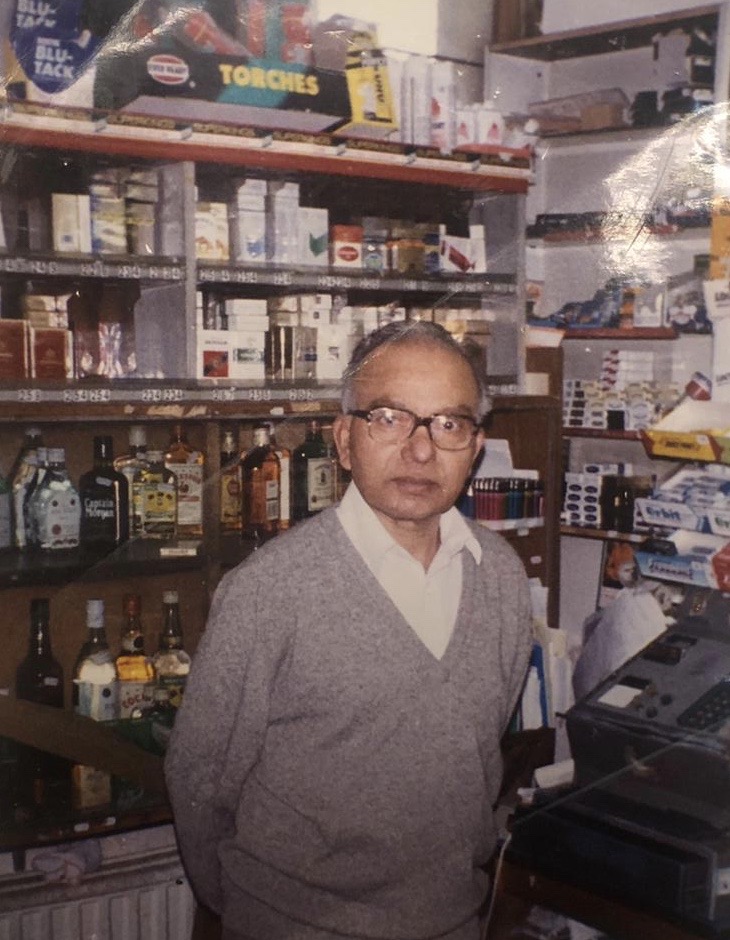
Showing posts with label HINDUS. Show all posts

Wednesday, 12 August 2020

BRITISH PROPAGANDA TO PLEASE CHAMCHAS, 'HOUSE COOLIES', AND HINDU TOBACCO AND ALCOHOL DEALERS!


BRITISH PROPAGANDA TO PLEASE CHAMCHAS, 'HOUSE COOLIES', AND HINDU TOBACCO AND ALCOHOL DEALERS!
 

AN ONLINE AND PRINT PUBLICATION COMMITTED TO SHARING PERSPECTIVES FROM WOMEN AND NON-BINARY PEOPLE OF COLOUR [HOLY PIG?]

BUSINESS, NOT "Culture"!

How South Asian corner shop culture helped the UK survive Covid-19

As the nation was forced into lockdown, corner shops, the ailing bastion of an era gone-by, were suddenly given a new lease of life. Sana Haq explores their legacy and the lives of the South Asian families who often own them.

[HALAAL & TAYYAB???] Rows of Twix bars, gummy Haribos and fizzy flying saucers stack the shelves of my local corner shop in Wimbledon. Every Friday after school my brother and I would walk into All Seasons and push open the wide refrigerated crate, ogling at the selection of ice lollies and pastel-coloured Mini Milks. Seventeen years later, despite the passing of multiple indie coffee shops and overpriced clothing boutiques, our local convenience store is still a focal point of the community.

In fact, over the lockdown period corner shops and independent grocers have reported a 63% upsurge in trade. The three months leading to 17 May saw sales made by independently-owned retailers increase by more than two times that of the fastest-growing supermarket chain Co-op, according to the data, insights and consulting company Kantar. 

“The lockdown actually had a positive impact on our business,” says 26-year old Sultan Ahmed Sheikh, whose family owns a Londis convenience store in Aberfeldy Village, just north of the Thames. “People who would usually do their weekly shopping in larger stores were now coming to us for their essentials.”

The shop is manned by Sultan, his father Abdul Salam Sheikh, his two younger brothers Sadique and Samad, alongside his trusted childhood friend Wasim Ghaffar.

After saving the funds from a previously-owned video shop, Sultan’s father purchased the store from the local council in 2009. He also bought a flat in Aberfeldy Village. Reflecting on his childhood, Sultan says, “There were eight of us in a three-bedroom flat, but funnily, that was when life felt most grand.”

His grandparents migrated from Bangladesh to the UK in the 1960s during the passing of the Commonwealth Immigrants Act in 1962, which restricted the free movement of people from Commonwealth countries to Britain. Sultan’s father, Abdul, spent his late teens growing up in Tower Hamlets, but Sultan says he wasn’t made to feel as welcome as he expected. 

“The immigrant mentality my father had made him hungry to have something solid he could pass down to his children if the acceptance of Asian people in the workplace didn’t improve. He has passed the information he’s learnt to his children. We are now able to run the business while he can take more of a backseat and reap the fruits of his hard labour.”

Growing up atop the corner shop, Sultan has fond memories of serving a range of customers and befriending numerous locals. “The best thing about running a corner shop would be the small daily conversations that form into an in-depth dialogue between two people over the span of a couple years.”

[WOW!  SELLING HARAAM DRUGS?]  Sultan with a regular customer before he left the estate in 2019

The family’s long-standing relationship with customers has meant that during the lockdown they’ve been in tune with the needs of the community – setting up a delivery service for the elderly and the vulnerable, ordering in items that they wouldn’t usually stock and working with the council to provide food packs for NHS workers who were unable to find time to shop.

However, Sultan recognises the challenges that Covid-19 first imposed on his family. He says that local store owners had to use their initiative and take precautionary measures to protect their customers. For example, at first, his father had to remain absent from the shop after news reports suggested that South Asian people are 2.4 times more likely to test positive for the virus than their white peers. 

After easing into the lockdown, Sultan’s family have been able to benefit from customers’ lack of access to supermarket chains. “In terms of relationship with the local community our bond has never been stronger,” says Sultan.

“People who would usually do their weekly shopping in larger stores were now coming to us for their essentials”

“Customers have been showing their gratitude towards us by keeping our doors open during a pandemic. They’ve pointed out how they didn’t realise the importance of local businesses until the lockdown,” he adds. 

About 20 miles away is a Londis corner shop in Stoke Newington, owned by 58-year-old Mayank and 55-year-old Anju Patel. Like Sultan, their 26-year-old son Priyesh mentions the coronavirus pandemic as one of the major obstacles that his family has had to juggle. “Every shop owner had dealt with it [lockdown] the way they thought best,” he says.

Due to the government’s shambolic lack of guidance during the pandemic, Priyesh’s family decided to put their own measures in place. These included reducing hours significantly, limiting the number of people in the shop, placing screens in front of customers, offering PPE to members of staff and offering deliveries to vulnerable customers. 
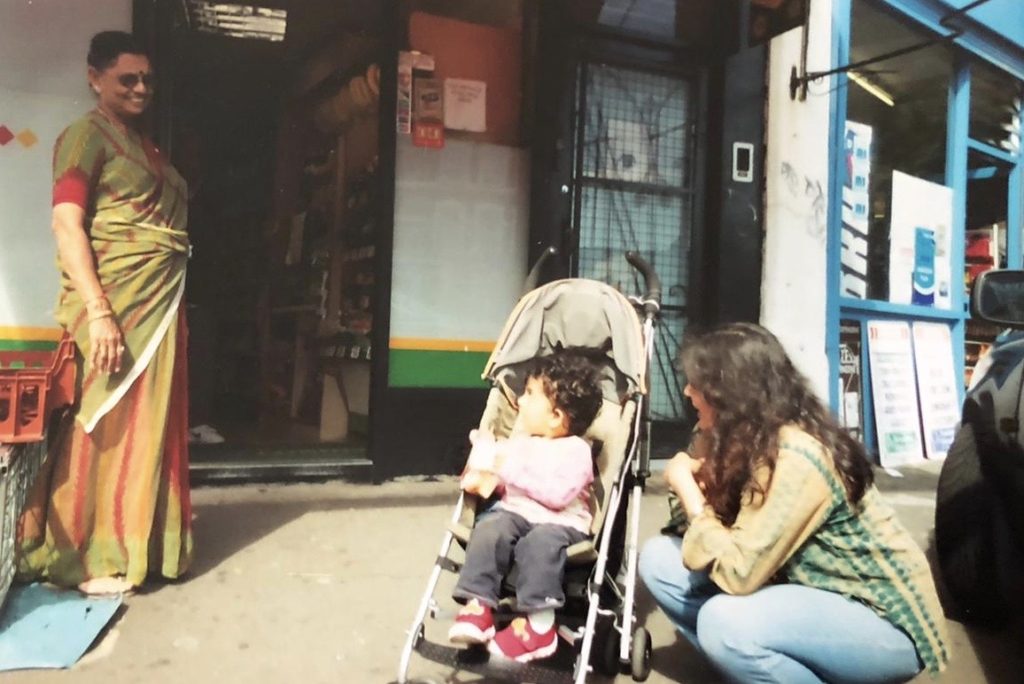
Priyesh’s grandma, Krisha (his niece) and his Mum outside of the shop around the 2010s

“It’s terrible to hear stories like Belly Mujinga’s. Working as a key worker, interacting with the public can be nerve-racking, so for that to happen to her, and for TfL not to keep her safe, was an awful story to hear in the midst of this. In terms of our shop, we kind of had to make rules as we went,” says Priyesh.

“Some customers would come in and comment on other shops, saying they hadn’t taken certain precautions. We thought this input from the public was pretty problematic at times because they had no idea what it was like to be working during a time when everyone was scared to leave their house.” 

But for Priyesh’s family, coalescing with the local community wasn’t always easy. “Most of the stories I hear from my parents tell me that when they first moved in the late seventies, there were lots of skinheads in the area thieving, which was hard to deal with.”

Priyesh’s grandparents moved to the UK from Zambia in 1972 due to increased Indophobia in the early seventies, sparked by the former President of Uganda, Idi Amin. They stayed in Leicester for three years, before travelling down to London in 1979. After purchasing the corner shop on Fountayne Road, they each retired and handed down the business, which has now endured three generations. 

“When me and my brother grew up on top of the shop, it was still rough in the 90s because there was so much struggle for so many people,” he says. However, streams of gentrification in the mid-2000s meant that his family had to respond to regeneration rapidly. “It changed the concept of our shop quite drastically.”

“My dad has always said that it’s a community shop, and the lockdown has really shown that”

The numbers speak for themselves. Between 2009 and 2017 the average price at which houses were purchased in Stoke Newington grew by 68%, rising to just over £1m, according to the property data network LonRes. Similar research from the digital product designer Amir Dotan has found that over the last 40 years, 21 new restaurants have cropped up in the local area. 

Speaking about appealing to customers new and old, Priyesh says, “There are still lots of old customers who are decades old, they still come to the shop. But there are lots of new people from houses which are now a million pounds, which weren’t a million pounds before.”

“It’s difficult because you’re working with two crowds. You’re working with an older crowd, with customers who are loyal to you and you want to support them. But you also want to maintain your business and so you have to respond to the changes in the area,” he adds. 

A few months in, Priyesh says that his family has found an equilibrium. “My dad has always said that it’s a community shop, and the lockdown has really shown that. Our customers help us and we help them – we have a really good vibe at the moment.”

“Corner shops have a history that people come for. There’s a smaller chain reaction when you go to a small store, because usually you’re supporting the people working there,” he adds. 

Nearly three years ago, 34-year-old Asiyah Javed and her husband Jawad purchased a Day Today Express shop in Falkirk, a large town between Edinburgh and Glasgow. Like Priyesh, Asiyah’s family migrated to the UK in 1972, hailing from Pakistan. Her parents and grandparents moved to Ashton in north England, working 14 to 16-hour shifts in a clothing factory in Manchester. Eight years later they bought their first corner shop in Hamilton, a lowland town south-east of Glasgow. Her family subsequently purchased stores across the country in Glasgow, Coatbridge, Larbert, Falkirk, Grangemouth and Alloa – retiring in the mid-2010s after a decline in physical health.

Asiyah and her husband Jawad outside of their shop in Falkirk during lockdown

Asiyah says that running a corner shop day-to-day is strenuous, and amidst the pandemic it’s been “non-stop”. But she makes it clear that she and Javed feel a duty to serve their local customers. “We are like a family with the people in our community, the lockdown has made us closer.”

Asiyah recalls meeting an elderly woman at the beginning of the lockdown who was devastated at the lack of handwash and hand gel available in stores, panicking because it was sold out everywhere. “I couldn’t sleep all night, I decided I needed to act. I went to the shop the next morning and started making hand care packages,” she says. 

In the end, they spent about £2000 giving customers over the age of 65 free antibacterial hand gel, cleaning wipes and face masks. “We all need to look out for each other,” she adds. “If you have a corner shop then you have a local community shopping there. You should support them when they need you.”

“Elderly people have more of a chance of catching the virus so they need more help and support. Their families are in lockdown, so we try our best to help all our elderly community.”

“If you have a corner shop then you have a local community shopping there. You should support them when they need you”

Sultan, Priyesh and Asiyah have symbiotic relationships with their local communities, but their accounts of running a corner shop are still prefaced by the institutional racism that runs through Britain’s history. In the 1970s and 1980s, South Asian factory workers in the UK began to lose their jobs after the decline of traditional labour-intensive industries. 

The simultaneous expansion of supermarket chains postwar meant that provincial grocery stores were likely to close, unless they were part of groups like Spar or Londis. Members from these conglomerates purchased smaller village stores from wholesalers. More often than not, your local corner shop will be headed by a Londis brand as opposed to being independently-owned.

Racial exclusion and a lack of economic opportunity meant that South Asian workers turned to the establishment of their own small businesses, purchasing corner shops and local restaurants. By 1991, about one quarter of South Asian people in Britain were self-employed. 

Prior to that, in the late sixties, the xenophobic Conservative MP Enoch Powell made his “Rivers of Blood” speech, flagrantly comparing mass migration to “watching a nation busily engaged in heaping up its own funeral pyre”.

“We had real problems with Enoch Powell followers. It wasn’t an easy experience. People would say to be careful, ‘Don’t look people in the eye just go quickly and come quickly,’” says  69-year-old Ram Gidoomal, CBE and Chairman of Traidcraft plc, whose family once owned multiple corner shops in West London. 

Ram has long been privy to the waves of oppression that strands of South Asian people have endured. 
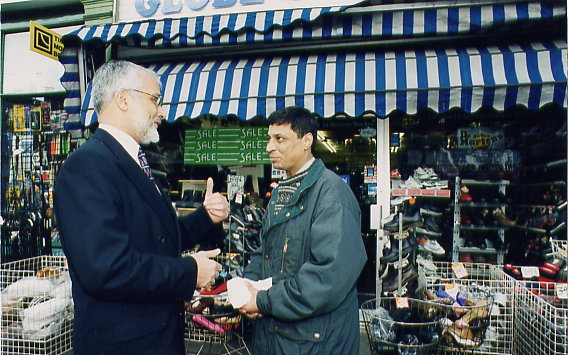
Ram with the owner of Global Footwear, where his family’s shop used to be

About two weeks before the Partition of India, Ram’s family fled from what would become Pakistan and landed in Kenya, travelling by ship to a port in Mombasa. “Everybody was moving desperately. That was the first migration, losing everything and starting life again.” 

In December 1950 Ram was born in Mombasa, his biological father passing away six weeks later. In 1966 Ram’s paternal uncle, who he refers to as his “earthly father”, was handed a deportation notice. Ram was the youngest of four brothers, moving to the UK with 11 family members over a period of a few months. He set foot in London as a refugee on 2 January, 1967. “It was freezing cold and we found ourselves, all 15 of us, looking for accommodation and income.” [I was deported to Paris in Janury 1968???]

As soon as they arrived, a friend advised his family to buy a corner shop. They had moved from a 15-bedroom living space in Kenya to a £150 corner shop on Uxbridge Road in Shepherd’s Bush, christening it G.Bharat. 

Within three months of his arrival, Ram’s earthly father passed away. “He put me in charge of the money because I had done my O-Levels. I was there footing all the banking. My other brothers were all good sales people. They would stand in front of the shop and sell cigarettes and chocolates.” 

“I had early morning newspaper rounds and then school, then I would go back and run the shop and do homework,” he says. He eventually gained a scholarship to go to Imperial College.

“We provided local therapy. It was fun because we were still one family”

When asked about engaging with the local community, Ram says “We didn’t.” However, he does remember forging bonds with fellow South Asian, Yugoslavian, Nigerian, Ghanaian and Irish migrant communities. 

“In that sense, the Irish communities were the people who helped us to make money.” Ram’s family would ask Irish customers what they were missing from their home, and which goods they no longer had access to. He cites publications like the Irish Independent and the Irish Times as newspapers that they imported for Irish customers, as well as Carrolls Number 1 cigarettes.

His family eventually acquired six corner shops, which he describes as “emotional surgeries”. “We provided local therapy. It was fun because we were still one family. We were all together and we were happy – you just had to survive,” he adds. 

Since the late 1980s, when Ram’s family sold the first shop, the image of South Asian-owned corner shops has been repurposed in popular culture. Known for their 1990s hit ‘Brimful of Asha’, the British rock band Cornershop reference the socio-cultural influence of corner shops in the UK at the time in their stage name. The band’s frontman Tjinder Singh identifies with his Indian heritage, deliberately foregrounding the stereotype of South Asian corner shops and attributing his politically confrontational lyricism to his dual British Asian identity. 

Many British soap operas chalk out a host of South Asian-owned corner shops in various storylines, including Dev Alahan’s store in Coronation Street and the green newsagents First ‘Til Last owned by Ashraf and Sufia Karim in Eastenders in the 1990s. More recently the film director, actor and screenwriter Islah Abdur-Rahman turned his comedy web series Corner Shop Show into a feature-length film in 2019, following the main character Malik as he steps into his father’s shoes of steering the family business. 

Over the past 50 years, South Asian-owned corner shops have maintained strong footholds across the UK, allowing locals to “self-organise”, says Dr Noha Nasser, an architect and academic who researches the influence that Muslim communities have on the urban morphology of British cities. “For some minority communities, the corner shop remains an important part of their social fabric,” she adds.

Withstanding waves of socio-political change such as Powellism, Brexit and Covid-19, corner shops continue to act as sites of congregation for Britain’s migrant communities. 

As Sultan says, “A local family owned store is a community hub to pass through and bump into old friends – it keeps bridges strong.”


Saturday, 9 December 2017

Kill Jesus! Crucify him! Pontius Pilate asked ihe Jews what he had done wrong.


The biggest Hanukkah snub of the usual suspects came from President John F. Kennedy in 1962, when he mentioned every religious denomination but the Jews during a Christmas address: 

"Muslims, Hindus, Buddhists, as well as Christians, pause from their labors the 25th day of December to celebrate the birthday of the Prince of Peace. There could be no more striking proof that Christmas is truly the universal holiday of all men." 

Indeed, the oh-so-evil Muslims (rolling eyes sarcastically) revere Jesus as a Holy Prophet; and Buddhists and Hindus  not only respect his moral teachings, but you'll never hear one of them take offense to the term "Merry Christmas" -- let alone demand that the White House honor the Buddha or Krishna. No. Only certain chosenites recoil in horror at the term -- which is why so many Boobuses now walk around wishing their own Christian friends and family a "Happy Holiday!" (barf!)


DECEMBER RE-ENROLLMENT PERIOD
Drag to pan
Pepe the "alt-right" frog reads the ANYT
SATURDAY / DECEMBER 9, 2017

N Y Times: Congressional

Sunday, 12 November 2017

I LOVE AND WORSHIP THE BRITISH FOR NEVER STOPPING MASSMURDERING OUR UNDESIRED HUMAN POPULATIONS!

INTRODUCED BY KOEN ROFFEL

My Son, Freemasons, Communists, Socialists, Secularists, Britain, Switzerland, Germany, France, Australia, Canada, New Zealand, India, South Africa, Russia, China, the Vatican, Christian Zionists, and APARTHEID Israel are the worst scums on this planet!

AND, MOST OF US ARE SUCH HYPOCRITES, SELFISH, AND COWARDS!

BAFS
Monday 13th of Novemer 2017


https://www.youtube.com/watch?v=f7CW7S0zxv4

CHURCHILL MURDERED ONLY 4 MILLION BENGALIS - OF THAT "FOUL RACE" OF "HINDUS"!


MASSMURDER, the British don’t want you to know about – They systematically starved to death over 60 millions of Eastern Indians!


Theory. Utopia. Empathy. Ephemeral arts – EST. 1990 – ATHENS LONDON NEW YORK

GENOCIDE, THE BRITISH DON’T WANT YOU TO KNOW ABOUT British Colonials Starved to Death 60 million-plus Indians, But, Why? by Ramtanu Maitra

in Global movement

42 Votes


British Colonials Starved to Death 60 million-plus Indians, But, Why?

kolaz1
by Ramtanu Maitra
July 3, 2015 EIR


The chronic want of food and water, the lack of sanitation and medical help, the neglect of means of communication, the poverty of educational provision, the all-pervading spirit of depression that I have myself seen to prevail in our villages after over a hundred years of British rule make me despair of its beneficence. — Rabindranath Tagore

If the history of British rule in India were to be condensed to a single fact, it is this: there was no increase in India’s per-capita income from 1757 to 1947.[1]

Churchill, explaining why he defended the stockpiling of food within Britain, while millions died of starvation in Bengal, told his private secretary that “the Hindus were a foul race, protected by their mere pullulation from the doom that is their due.”[2]
 

June 27— During its 190 years of looting and pillaging, the Indian Subcontininent as a whole underwent at least two dozen major famines, which collectively killed millions of Indians throughout the length and breadth of the land. How many millions succumbed to the famines cannot be fully ascertained. However, colonial rulers’ official numbers indicate it could be 60 million deaths. In reality, it could be significantly higher.pic1
 

British colonial analysts cited droughts as the cause of fallen agricultural production that led to these famines, but that is a lie. British rulers, fighting wars in Europe and elsewhere, and colonizing parts of Africa, were exporting grains from India to keep up their colonial conquests—while famines were raging. People in the famine affected areas, resembling skeletons covered by skin only, were wandering around, huddling in corners and dying by the millions. The Satanic nature of these British rulers cannot be overstated.

A Systematic Depopulation Policy

Although no accurate census figure is available, in the year 1750 India’s population was close to 155 million. At the time British colonial rule ended in 1947, undivided India’s population reached close to 390 million. In other words, during these 190 years of colonial looting and organized famines, India’s population rose by 240 million. Since 1947, during the next 68-year period, Indian Subcontininent’s population, including those of India, Pakistan, and Bangladesh, has grown to close to 1.6 billion. Thus, despite poverty and economic depravity in the post-independent Indian Subcontininent, during those 68 years population has grown by almost 1.2 billion.
Records show that during the post-independence period, the Subcontininent has undergone drought conditions in parts of the land from time to time, but there was no famine, although thousands still die in the Subcontininent annually due to the lack of adequate amount of food, a poor food distribution system, and lack of sufficient nourishment. It is also to be noted that before the British colonials’ jackboots got firmly planted in India, famines had occurred but with much less frequency—maybe once in a century.
There was indeed no reason for these famines to occur They occurred only because The Empire engineered them, intending to strengthen the Empire by ruthless looting and adoption of an unstated policy to depopulate India. This, they believed would bring down the Empire’s cost of sustaining India.

 
Take, for instance, the case of Bengal, which is in the eastern part of the Subcontininent where the British East India Company (HEIC, Honorable East India Company, according to Elizabeth I’s charter) had first planted its jackboots in 1757. The rapacious looters, under the leadership of Robert Clive—a degenerate and opium addict, who blew his brains out in 1774 in the London Berkley Square residence he had procured with the benefits of his looting—got control of what is now West Bengal, Bangladesh, Bihar, and Odisha (earlier, Orissa), in 1765. At the time, historical records indicate India represented close to 25% of the world’s GDP, second only to China, while Britain had a paltry 2%. Bengal was the richest of the Indian provinces.

 
Following his securing control of Bengal by ousting the Nawab in a devious battle at Plassey (Palashi), Clive placed a puppet on the throne, paid him off, and negotiated an agreement with him for the HEIC to become the sole tax collector, while leaving the nominal responsibility for government to his puppet. That arrangement lasted for a century, as more and more Indian states were bankrupted to facilitate future famines. The tax money went into British coffers, while millions were starved to death in Bengal and Bihar.

 
Clive, who was made a Fellow of the Royal Society in 1768 and whose statue stands near the British Empire’s evil center, Whitehall, near the Cabinet War Room, had this to say in his defense when the British Parliament, playing “fair,” accused him of looting and other abuses in India:

Consider the situation which the Victory of Plassey had placed on me. A great Prince was dependent upon my pleasure; an opulent city lay at my mercy; its richest bankers bid against each other for my smiles; I walked through vaults which were thrown open to me alone, piled on either hand with gold and jewels! By God, Mr. Chairman, at this moment I stand astonished at my own moderation.
 
However, Clive was not the only murderous British colonial ruler. The British Empire had sent one butcher after another to India, all of whom engineered looting and its consequent depopulation.
pic2

By 1770, when the first great famine occurred in Bengal, the province had been looted to the core. What followed was sheer horror. Here is how John Fiske in his American Philosopher in the Unseen World depicted the Bengal famine:

All through the stifling summer of 1770 the people went on dying. The husbandmen sold their cattle; they sold their implements of agriculture; they devoured their seed-grain; they sold their sons and daughters, till at length no buyer of children could be found; they ate the leaves of trees and the grass of the field. . . . The streets were blocked up with promiscuous heaps of the dying and dead. Interment could not do its work quick enough; even the dogs and jackals, the public scavengers of the East, became unable to accomplish their revolting work, and the multitude of mangled and festering corpses at length threatened the existence of the citizens…. [3]


Was there any reason for the famine to occur? Not if the British had not wanted it. Bengal, then, as now, harvested three crops a year. It is located in the delta of the Gangetic plain where water is more than plentiful. Even if drought occurs, it does not destroy all three crops. Moreover, as was prevalent during the Moghul days, and in earlier time, the surplus grain was stored to tide the population over if there were one or two bad crops.
 

But the looting of grains carried out by Clive, and his gang of bandits and killers, drained grain from Bengal and resulted in 10 million deaths in the great famine, eliminating one-third of Bengal’s population.
 

It should be noted that Britain’s much-touted industrial revolution began in 1770, the very same year people were dying all over Bengal. The Boston Tea Party that triggered the American Revolution had taken place in 1773. The Boston Tea Party made the Empire realize that its days in America were numbered, and led Britain to concentrate even more on organizing the looting of India.

Why Famines Became So Prevalent During the British Raj Days

The prime reason why these devastating famines took place at a regular intervals, and were allowed to continue for years, was the British Empire’s policy of depopulating its colonies. If these famines had not occurred, India’s population would have reached a billion people long before the Twentieth Century arrived. That, the British Empire saw as a disaster.
To begin with, a larger Indian population would mean larger consumption by the locals, and deprive the British Raj to a greater amount of loot. The logical way to deal with the problem was to develop India’s agricultural infrastructure. But that would not only force Britain to spend more money to run its colonial and bestial empire; it would also develop a healthy population which could rise up to get rid of the abomination called the British Raj. These massive famines also succeeded in weakening the social structure and backbone of the Indians, making rebellions against the colonial forces less likely. In order to perpetuate famines, and thus depopulate the “heathen” and “dark” Indians, the British imperialists launched a systematic propaganda campaign. They propped up the fraudster Parson Thomas Malthus and promoted his non-scientific gobbledygook, “The Essay on Population.” There he claimed:

This natural inequality of the two powers of population and of production in the earth, and that great law of our nature which must constantly keep their effects equal, form the great difficulty that to me appears insurmountable in the way to the perfectibility of society. All other arguments are of slight and subordinate consideration in comparison of this. I see no way by which man can escape from the weight of this law which pervades all animated nature.


Although Malthus was ordained in the Anglican Church, British Empire made him a paid “economist” of the British East India Company, which, with the charter from Queen Elizabeth I under its belt, monopolized trade in Asia, colonizing vast tracts of the continent using its well-armed militia fighting under the English flag of St. George.
 

Malthus was picked up at the Haileybury and Imperial Service College, which was also the recruiting ground of some of the worst colonial criminals. This college was where the makers of British Empire’s murderous policies in India were trained. Some prominent alumni of Haileybury include Sir John Lawrence (Viceroy of India from 1864-68) and Sir Richard Temple (Lt. Governor of Bengal and later, Governor of Bombay presidency).

 
While Parson Malthus was putting forward his sinister “scientific theory” to justify depopulation as a natural and necessary process, The British Empire collected a whole bunch of other “economists” who wrote about the necessity of free trade. Free trade played a major role in pushing through the Empire’s genocidal depopulation of India, through the British Raj’s efforts. In fact, free trade is the other side of the Malthus’ population-control coin.
By the time the great famine of 1876 arrived, Britain had already built some railroads in India. The railroads, which were touted as institutional safeguards against famines, were instead used by merchants to ship grain inventories from outlying drought-stricken districts to central depots for hoarding. In addition, free traders’ opposition to price control ushered in a frenzy of grain speculation. As a result, capital was raised to import grains from drought-stricken areas, and further the calamity. The rise of price of grain was spectacularly rapid, and grain was taken from where it was most needed, to be stored in warehouses until the prices rose even higher.
The British Raj knew or should have known. Even if the British rulers did not openly encourage this process, they were fully aware of it, and they were perfectly comfortable in promoting free trade at the expense of millions of lives. This is how Mike Davis described what happened:

The rise [of prices] was so extraordinary, and the available supply, as compared with well-known requirements, so scanty that merchants and dealers, hopeful of enormous future gains, appeared determined to hold their stocks for some indefinite time and not to part with the article which was becoming of such unwonted value. It was apparent to the Government that facilities for moving grain by the rail were rapidly raising prices everywhere, and that the activity of apparent importation and railway transit, did not indicate any addition to the food stocks of the Presidency . …retail trade up-country was almost at a standstill. Either prices were asked which were beyond the means of the multitude to pay, or shops remained entirely closed.


At the time, Lord Lytton, a favorite poet of Queen Victoria who is known as a “butcher” to many Indians, was the Viceroy. He wholeheartedly opposed all efforts to stockpile grain to feed the famine-stricken population because that would interfere with market forces. In the autumn of 1876, while the monsoon crop was withering in the fields of southern India, Lytton was absorbed in organizing the immense Imperial Assemblage in Delhi to proclaim Victoria Empress of India.
How did Lytton justify this? He was an avowed admirer and follower of Adam Smith. Author Mike Davis writes that Smith

a century earlier in The Wealth of Nations had asserted (vis-à-vis the terrible Bengal droughtfamine of 1770) that famine has never arisen from any other cause but the violence of government attempting, by improper means, to remedy the inconvenience of dearth, Lytton was implementing what Smith had taught him and other believers of free trade. Smith’s injunction against state attempts to regulate the price of grain during the 1770 famine had been taught for years in the East India Company’s famous college at Haileybury.[4]
Lytton issued strict orders that “there is to be no interference of any kind on the part of Government with the object of reducing the price of food,” and “in his letters home to the India Office and to politicians of both parties, he denounced ‘humanitarian hysterics’.” By official diktat, India, like Ireland before it, had become a Utilitarian laboratory where millions of lives were gambled, pursuant to dogmatic faith in omnipotent markets overcoming the “inconvenience of dearth.”[5]

The Great Famines

Depicting the two dozen famines that killed more than 60 million Indians would require a lot of space, so I limit myself here to those that killed more than one million:
The Bengal Famine of 1770: This catastrophic famine occurred between 1769 and 1773, and affected the lower Gangetic plain of India. The territory, then ruled by the British East India Company, included modern West Bengal, Bangladesh, and parts of Assam, Orissa, Bihar, and Jharkhand. The famine is supposed to have caused the deaths of an estimated 10 million people, approximately one-third of the population at the time.
pic3

The Chalisa Famine of 1783-84: The Chalisa famine affected many parts of North India, especially the Delhi territories, present-day Uttar Pradesh, Eastern Punjab, Rajputana (now named, Rajasthan), and Kashmir, then all ruled by different Indian rulers. The Chalisa was preceded by a famine in the previous year, 1782-83, in South India, including Madras City (now named Chennai) and surrounding areas (under British East India Company rule), and in the extended Kingdom of Mysore. Together, these two famines had taken at least 11 million lives, reports indicate.

The Doji Bara Famine (or Skull Famine) of 1791- 92: This famine caused widespread mortality in Hyderabad, Southern Maratha Kingdom, Deccan, Gujarat, and Marwar (also called Jodhpur region in Rajasthan). The British policy of diverting food to Europe, of pricing the remaining grain out of reach of native Indians, and adopting agriculture policy that destroyed food production, was responsible for this one. The British had surplus supplies of grain, which was not distributed to the very people that had grown it. As a result, about 11 million died between 1789-92 of starvation and accompanying epidemics that followed.

The Upper Doab Famine of 1860-61: The 1860-61 famine occurred in the British-controlled Ganga-Yamuna Doab (two waters, or two rivers) area engulfing large parts of Rohilkhand and Ayodhya, and the Delhi and Hissar divisions of the then-Punjab. Eastern part of the princely state of Rajputana. According to “official” British reports, about two million people were killed by this famine.

The Orissa Famine of 1866: Although it affected Orissa the most, this famine affected India’s east coast along the Bay of Bengal stretching down south to Madras, covering a vast area. One million died, according to the British “official” version.

The Rajputana famine of 1869: The Rajputana famine of 1869 affected an area of close to 300,000 square miles which belonged mostly to the princely states and the British territory of Ajmer. This famine, according to “official” British claim, killed 1.5 million.

The Great Famine of 1876-78: This famine killed untold numbers of Indians in the southern part and raged for about four years. It affected Madras, Mysore, Hyderabad and Bombay (now called, Mumbai). The famine also subsequently visited Central Province (now called, Madhya Pradesh) and parts of undivided Punjab. The death toll from this famine was in the range of 5.5 million people. Some other figures indicate the number of deaths could be as high as 11 million.

Indian famine of 1896-97 and 1899-1900: This one affected Madras, Bombay, Deccan, Bengal, United Provinces (now called, Uttar Pradesh), Central Provinces, Northern and eastern Rajputana, parts of Central India, and Hyderabad: six million reportedly died in British territory during these two famines. The number of deaths occurred in the princely states is not known.

The Bengal Famine of 1943-44: This Churchill-orchestrated famine in Bengal in 1943-1944 killed an estimated 3.5 to 5 million people.

Relief Camps, or Concentration camps

There were several policy-arrows which Adolf Hitler might have borrowed from the British quiver to kill millions, but one that he borrowed for certain in setting up his death camps, was how the British ran the camps to provide “relief” to the starving millions. Anyone who entered these relief camps, did not exit alive.
Take the actions of Viceroy Lytton’s deputy, Richard Temple, another Haileybury product imbued with the doctrine of depopulation as the necessary means to keep the Empire strong and vigorous. Temple was under orders from Lytton to make sure there was no “unnecessary” expenditure on relief works.
According to some analysts, Temple’s camps were not very different from Nazi concentration camps. People already half-dead from starvation had to walk hundreds of miles to reach these relief camps. Additionally, he instituted a food ration for starving people working in the camps, which was less than that was given to the inmates of Nazi concentration camps.

The British refused to provide adequate relief for famine victims on the grounds that this would encourage indolence. Sir Richard Temple, who was selected to organize famine relief efforts in 1877, set the food allotment for starving Indians at 16 ounces of rice per day—less than the diet for inmates at the Buchenwald concentration camp for the Jews in Hitler’s Germany. British disinclination to respond with urgency and vigor to food deficits resulted in a succession of about two dozen appalling famines during the British occupation of India. These swept away tens of millions of people. The frequency of famine showed a disconcerting increase in the nineteenth century.[6]
It was deliberate then, and it’s deliberate now.
______________
1. Davis, Mike. Late Victorian Holocausts: El Nino Famines and the Making of the Third World, London, Verso Books, 2001.

2. Madhusree Mukerjee, Churchill’s Secret War: The British Empire and the Ravaging of India during World War II, New York: Basic Books.
3. Davis, op. cit.
4. Ibid.
5. Ibid
6. Bhatia, B.M., Famines in India, A Study in Some Aspects of the Economic History of India, 1860-1945, Asia Publishing House, Bombay, 1963.

Dr Ramtanu Maitra
A specialist on South Asian Affairs who operates out of Washington D.C. Ramtanu Maitra specialises on strategic and infrastructural developmental studies with the focus on South Asia.
He holds a Masters Degree in Structural Engineering and was working as a Senior Project Engineer with the Nuclear Power Services, Secaucus, NJ.
Ramtanu Maitra participated in developing a document, India: An agro-industrial superpower by 2020, in 1981.
He established and published a quarterly journal, Fusion Asia, on science, technology, energy and economics from New Delhi for more than 10 years (1984-1994).
He wrote and published the first feature report on India’s high-energy physics program based in PRL, Ahmedabad. Prepared and published a detailed report on Ganges River Valley Development that was presented at an international conference inaugurated by the late president of India, Shri K.R. Narayanan, then Minister for Planning.
He participated on behalf of Fusion Asia on a feasibility study that also involved the Mitsubishi Research Institute (Tokyo) and the Thai Citizen Forum. Presented papers at a number of international conferences on strategic infrastructures in Bogota, Colombia, Tokyo, Japan, Kolkata, Indore, Madurai, Indore, New Delhi, among other Indian cities.
In 1994, Shri Maitra established New Delhi bureau for Asia Times, a Bangkok-based news daily published simultaneously from Bangkok, Hong Kong, Kuala Lumpur and New York.
Presently, he conducts research, analysis, writing on international economic and strategic developments for publications internationally, including: Foresight (Japan); Aakrosh, Agni, Indian Defense and Technology (India); Asia Times Online (Hong Kong); and Executive Intelligence Review (USA).
http://www.sasfor.com/about.html
Ramtanu Maitra is a regular columnist with the Executive Intelligence Review (EIR), a news weekly published from Washington DC. He writes columns for Asia Times of Hong Kong, Frontier Post of Peshawar and some other newspapers in Asia on South Asian political economy and Asian security. He has written on terrorism in a number of publications in the United States and India.  

MORE ARTICLES BY DR MAITRA >

http://www.indiandefencereview.com/author/ramtanumaitra/

http://www.indiandefencereview.com/author/ramtanumaitra/?page=2
http://www.sasfor.com/india/category/ramtanu%20maitra


PDF download - Tell the Truth & Shame the Devil - englisch UND deutsch


Deutscher Titel:
"Wahrheit sagen, Teufel jagen"

Download:
Das Buch steht hier als PDF in englischer wie auch in deutscher Sprache kostenlos zum herunterladen bereit!

📖 Tell the Truth and Shame the Devil
📖 Wahrheit sagen, Teufel jagen

(Demnächst auch in gängigen eBook-Formaten. Herausgeber der deutschen Fassung ist Thom Ram, bumibahagia.com)

Gerard Menuhin, der Sohn des Jahrhundert-Geigers Yehudi Menuhin, erzeugt ein Jahrhundert-Beben der größten Lüge der Menschheitsgeschichte:

„Der Holocaust ist die größte Lüge der Geschichte. Deutschland hat keine Schuld am Zweiten Weltkrieg und Adolf Hitler war der einzige Staatsmann der Welt, der die Welt vor der plutokratisch-jüdischen Gefahr hätte retten können, um den unterjochten Planeten wieder zu befreien.“ (Gerard Menuhin)
Seite speichern, als Lesezeichen und mit Freunden und Bekannten teilen!

www.goodreads.com says:
This book is of monumental importance for the people of the world today. Many know that something is not right in the world. Nations engage in perpetual war while bankers and armaments makers line their pockets from the carnage. The average citizen of the world has been cut out of the decision-making process of government, whether he lives in a democracy, republic, theocracy or dictatorship. All the while, the ruling elite grow stronger and richer, as the real producers struggle to survive. Behind the scenes, events are controlled by a coterie of ethnic puppet masters who work their marionettes in high places out of public view.


How did this world get to the dark place it is today? Who could have stopped it and what can we do today?


The book consists of three sections. The first section concerns Adolf Hitler, his character and intentions, and the real causes leading up to the outbreak of WWII, including the actions of the real culprits and the rejection of the great lie.


The second section enlarges on the activities of the real culprits, provides a historical overview of their progress, their nature, their power over finance and the media, and the methods by which they achieved it. It includes insights into Freemasonry, the European revolutions, the influence and control of education and foreign policy, the creation of the EU, the New World Order and the evolution of the plan through the same powers and their proxies, since the 17th century up to the present.


The third section concerns the First and Second World Wars (what the author refers to as “the Second Thirty Years War”), their conception, funding and inescapable continuity; current laws against freedom of expression, and the evolution of the Orwellian state; the importance of U.S. support for the Soviet Union throughout the Cold War, and Communism’s significance in the plan; the true origins of the enemy; Palestine’s occupation and its fate as an example of our common fate; plus much more.


The text is interspersed with “Memos from Today,” that emphasize its relevance by citing current events. Hundreds of quotes are included from a wide range of authoritative sources, original and translated.


The last pages of this manuscript comprise conclusions and predictions. The narrative is dense and packed with facts, and backed by expert testimony. At times, the style is personal, even casual, and absolutely non-intellectual. It has been assumed that a personal touch makes the contents more accessible. The author is the son of the great American-born violinist Yehudi Menuhin, who, though from a long line of rabbinical ancestors, fiercely criticized the foreign policy of the state of Israel and its repression of the Palestinians in the Holy Land.

Quelle: www.goodreads.com


Declassified Secrets Sept 11 2001 ABEL DANGER Captain Sherlock Solves 911 Pentagon Attack


1,780 views
58 2 Share
Published on 4 Aug 2017
Geroge W Bush Air National Guard meets Field McConnell F-4 Phantom II #abeldanger Boeing’s Uninterruptible Auto pilot Investigation Field McConnell United States Marine and Global Operations Director of Abel Danger (AD) citizen journalists who joined forces to investigate Captain Sherlock Solves 911 9 11 Pentagon Attack Raytheon Drone A3 Skywarrior was the Small White JET seen impacting into the Pentagon on Sept 11 2001 not the American Airlines Flight 77 Boeing 757 which could not have been flown at 530 mph (853 km/h, 237 m/s, or 460 knots) ========================================== WHAT Hit the Pentagon on Sept 11 2001 Attack https://chemtrailsplanet.files.wordpr... Field McConnell is a career military and airline pilot with connections to the aircraft-related events of 9/11. His Air National Guard unit had F-16s over Washington DC on the morning of 9/11. Captain Charles ‘Chic’ Burlingame of American Airlines Flight 77 was his college classmate. The software used on the drones which were flown into the Twin Towers, Boeing Uninterruptable Auto-Pilot (BUAP) is his intellectual property. xxxxxxxxxxxxxxxxxxxxxxxxxx A Must See ! Share Link Below Declassified Secrets GOFER06 Pentagon 9/11 Attack Raytheon A3D Skywarrior ABEL Danger https://youtu.be/jxKCfXKpspg The World's First and Most Accurate Simulation of PENTAGON Attack SEPT 11 2001 Targeting the U.S.NAVY Able Danger Investigated Offices in the Washington DC Pentagon. LINK Here https://youtu.be/euyf6m7fGuo ------------------------------------------- McConnell claims it was this BUAP technology that was misappropriated by his sister, Kristine Marcy, and Hillary Clinton on that day, when the Establishment patsied Muslims to facilitate their ‘New American Century’. In December 2006, McConnell came forward about the ‘Boeing Uninterruptible Auto-pilot’ software and its role in 9/11, causing the FAA, US Department of Justice and the Airline Pilots Association attempt to silence him. McConnell then retired from Northwest Airlines and has since gone on to consult entities in Russia, Malaysia and Germany on how airliners can be taken down using illegal software modifications. Youtube Deep State Censorship FIELD MCCONNELL: HILLARY CLINTON’S CONNECTION TO 9/11 REVEALED :: LINK Below https://www.youtube.com/watch?v=qnNgK... 
 
Washington DC on morning of 9/11; Captain Charles 'Chic' Burlingame of American Airlnes Flight 77 ( Pentagon) was his college classmate, and the 'Boeing Uninterruptable Auto-Pilot' (BUAP} equipped drones were his intellectual property. It was this BUAP technology that was misused by Field McConnell's sister, Kristine Marcy, and Hillary Clinton as the Establishment patsied Muslims to facilitate their 'New American Century'.  
 
When Field exposed 'Boeing’s Uninterruptible Auto-pilot' in December 2006, the FAA, U S Department of Justice and most notably the Airline Pilots Association attempted to silence him regarding the Truth of 9/11. He immediately retired from Northwest Airlines and was recruited to fly Airbus jets in Kazakhstan where he flew for 18 months to round out his 31 year airline career. 
 
Field McConnell's expertise has been used by Russia, Malaysia, and Germany in explaining the four airliners taken down by the illegal modifications, which he first reported on 10 December, 2006. 
 
Declassified Secrets Sept 11 2001 ABEL DANGER Captain Sherlock Solves 911 Pentagon Attack https://youtu.be/A0vMAAkx624 Zig Zag Channel
