Viṣṇu as Vaikuṇṭha Caturmūrti - 4 FACED GOD
Definition of boar [Merriam-Webster Dictionary]
Definition of swine
Definition of pig
(Entry 1 of 2)
hindu aesthetic
About hindu aesthetic
Curating Hindu art and knowledge - a testament to the glorious culture and heritage of a resilient civilisation. https://www.patreon.com/hinduaesthetic
Jul 22, 2021·8 min read
The Vyūha doctrine of Vaiṣṇavism and its conception in the Nārāyaṇīya
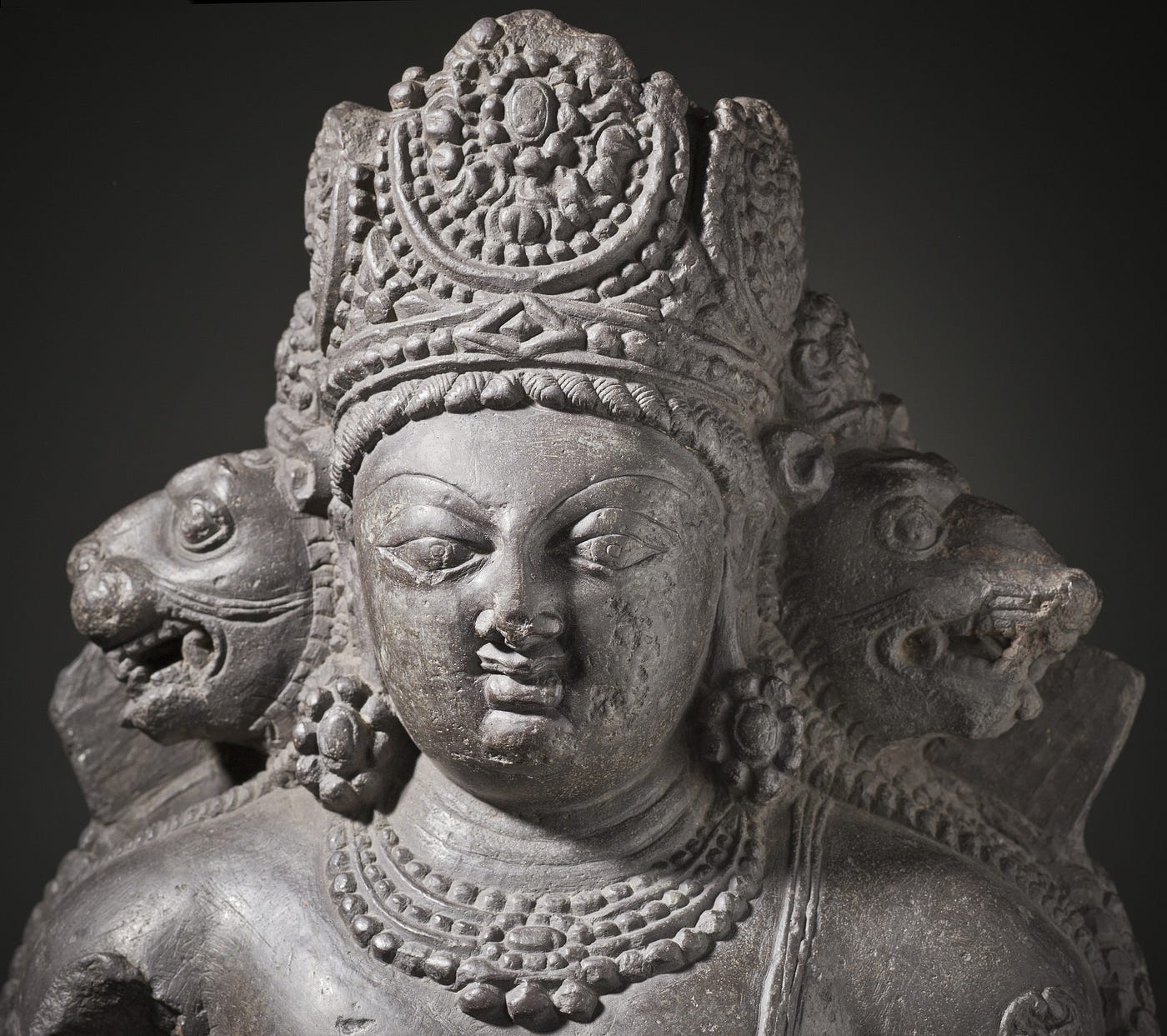
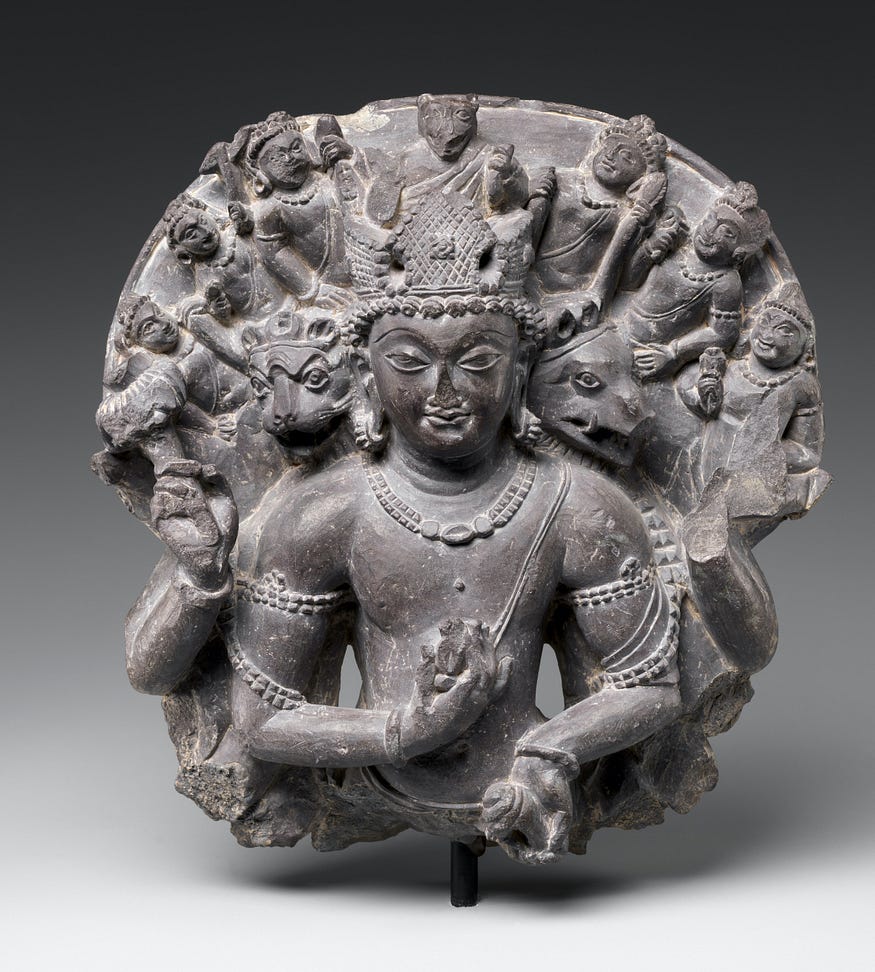
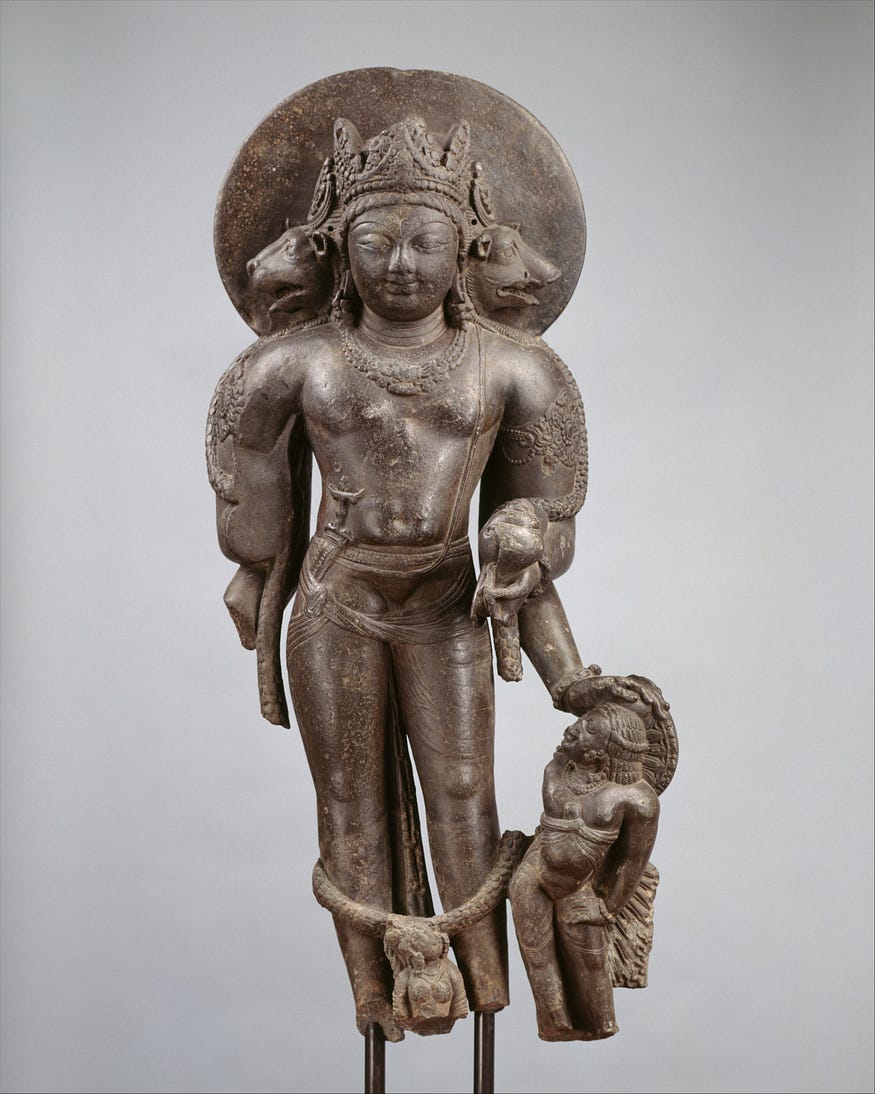
This iconography of Viṣṇu as Vaikuṇṭha Caturmūrti (‘‘the penetrating Lord of four visages’’) was first found in a 5th-century Vaiṣṇava Pañcarātra Saṃhita and reflects influences from the Gupta period (Mathura School) and the Gandhāra architectural tradition from as early as the 2nd century BC. A cult centered on this form of Viṣṇu developed in Kashmir in the 8–12th century, when the deity also enjoyed royal patronage in the region. While as per one interpretation, the animal heads represent Viṣṇu’s early avatāras Narasimha and Varāha, the more credible theory based on Pañcarātra texts relates the four heads to the Caturvyūha or the four vyūhas (manifestations) of Viṣṇu: named Vāsudeva, Saṃkarṣaṇa (also called Baladeva or Balarāma), Pradyumna and Aniruddha in the Viṣṇudharmōttara purāṇa.


Viṣṇu as Vaikuṇṭha Caturmūrti is imagined as one figure with eight arms and four heads is described in the Viṣṇudharmōttara purāṇa, though the common Vaikuṇṭha -Viṣṇu sculptures from Kashmir normally have four arms. According to the Pañcarātra doctrine, the four vyūhas also signify certain guṇas or postitive attributes which are responsible for the process of creation. Vāsudeva stands for strength (bala), Saṃkarsaṇa for knowledge or jñāna, Pradyumna for lordship and wealth (aiśvarya), and Aniruddha for potency (śakti).
In one verse of the Viṣṇudharmōttara (III 85.45) the guṇas are identified with the heads of the Vaikuṇṭha image by declaring that the theriomorphic form of the lion face or Saṃkarṣaṇa represents jñānavaktra, and the raudra face (or terrible form, composing the face on the back-side) representing aiśvarya.

ICONOGRAPHY
Vaikuṇṭha or Vaikuṇṭhanātha generally has four faces and eight hands, and is seated upon the mythical kite Garuḍa. In the right hands, he holds the gadā, khaḍga, bāṇa and and the cakra; in the left hands, śankha, khēṭaka, dhanus and parma. Of the four faces, the front one facing east is that of a man, the one facing South is that of a lion, the one to the west is that of a woman and the face to the north should be that of Varāha.
This type of icon of Vāsudeva consolidated into a single form called Vaikuṇṭha (literally, “the keen, the penetrating irresistible”) bearing the complexion of a water-laden cloud and the Kaustubha gem on his breast in the Viṣṇudharmōttara purāṇa. The iconography of the Vaikuṇṭha is also corroborated in the Jayākhya Saṃhita, a Pañcarātra text also dated to the Gupta period that describes the four-armed Vaikuṇṭha as follows: “The Lord, creator of the universe, is to be meditated upon as having four faces — Vaikuṇṭha [or Vāsudeva], Narasiṃha, Varāha, and Kapila, with four arms, His hands holding the conch-shell, the disc, the club, and the lotus . . . mounted on Garuḍa. . . .” The sculpture may also have figures of Cakrapuruṣa and Gadādevi.
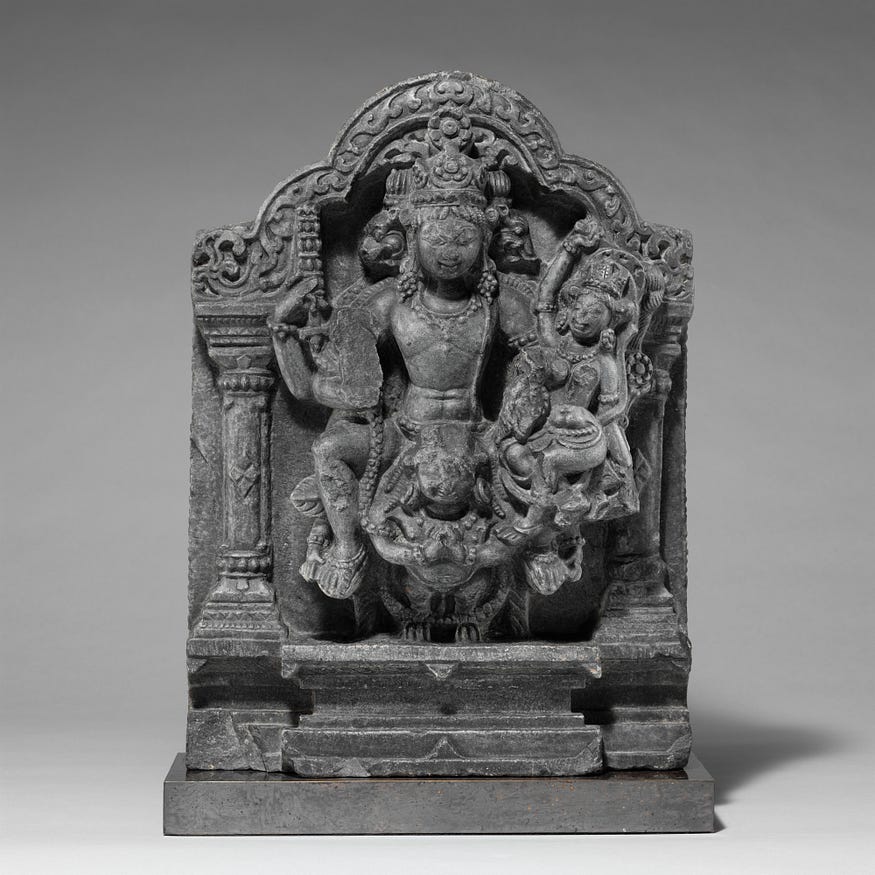
The name Vaikuṇṭha is reserved for four-faced Viṣṇu images where the god, either alone or with his consort, rides on Garuḍa. When Garuḍa is absent the designation Caturmūrti is appropriate. The designation Caturvyūha is applied to both those icons, regardless of the presence of Garuḍa and His consort, since the focus is on the theme of divine emanation by depicting a fourfold Vaiṣṇava image.
All the iconographic variations are expressions of the identical vyūha doctrine, with the four configurations representing the emanations of God, emphasizing the distinction between God as the ultimate supernal power and the emanations arising from that power. The eternal, all-encompassing ‘One’ has the potentiality to bring forth innumerable forms, of which the vyūhas render form to an otherwise formless source of creation in order to provide man with objects of devotion and veneration.
SYMBOLISM
The theological doctrine Vaiṣṇavism developed to explain the nature of the Supreme constructed the concept of vyūha (literally, “placing apart; orderly arrangement”) attempts to outline the fundamental nature of the supreme Bhagavān as well as the relationship between God and all his manifestations or aspects. The power all-pervading Brahman lends to its manifestation in a series successive aspects, here four — caturvyūha — that are the cause for the entirety of the creation and existence of the phenomenal world. In this way, the vyūha doctrine affirms a causational link between the numinous or the divine and the phenomenal, without assigning limitations conditioned by external factors such as time, change, form, or will upon the Supreme. In this system, Vāsudeva, literally, “the indwelling deity,” is the first emanation and the fountainhead of the successive emanations which may be represented either anthropomorphically or theriomorphically in Hindu art. The vyuhas therefore quite literally spring from the fountainhead, that is, from the central figure of Vāsudeva, and together represent cosmic completeness.
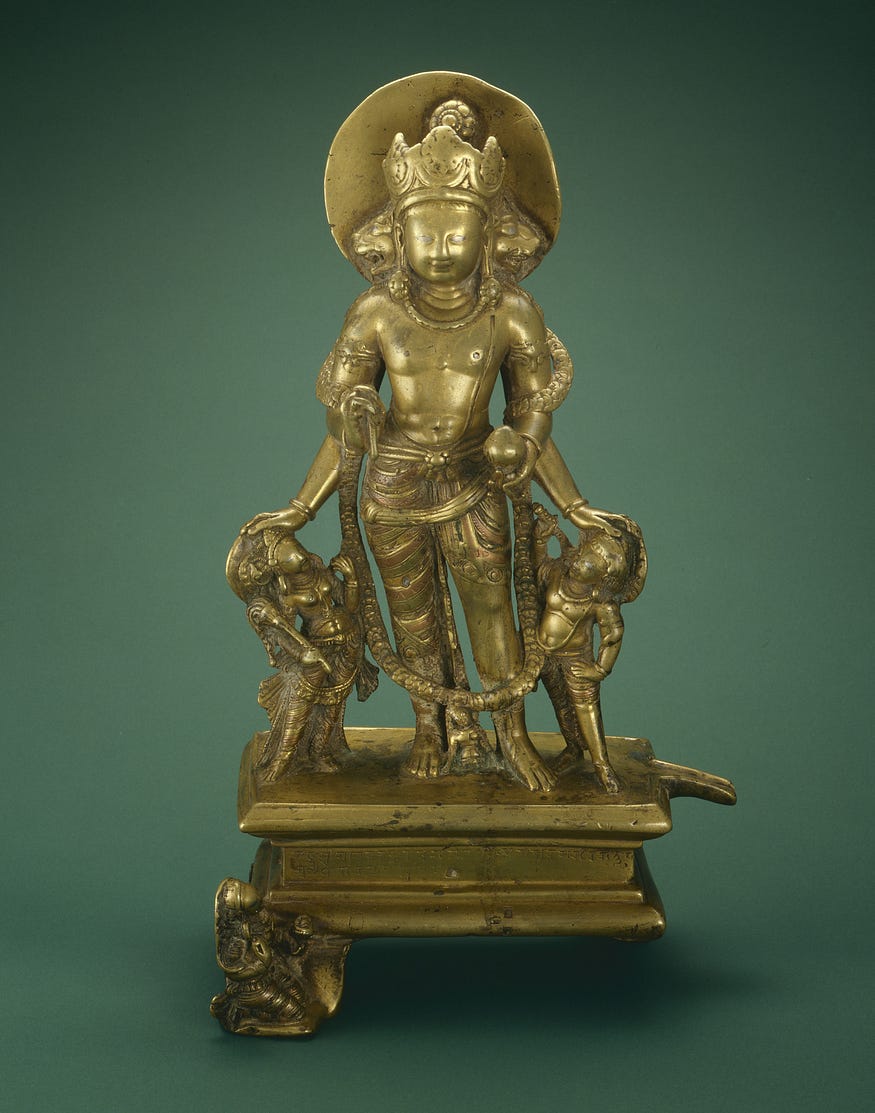
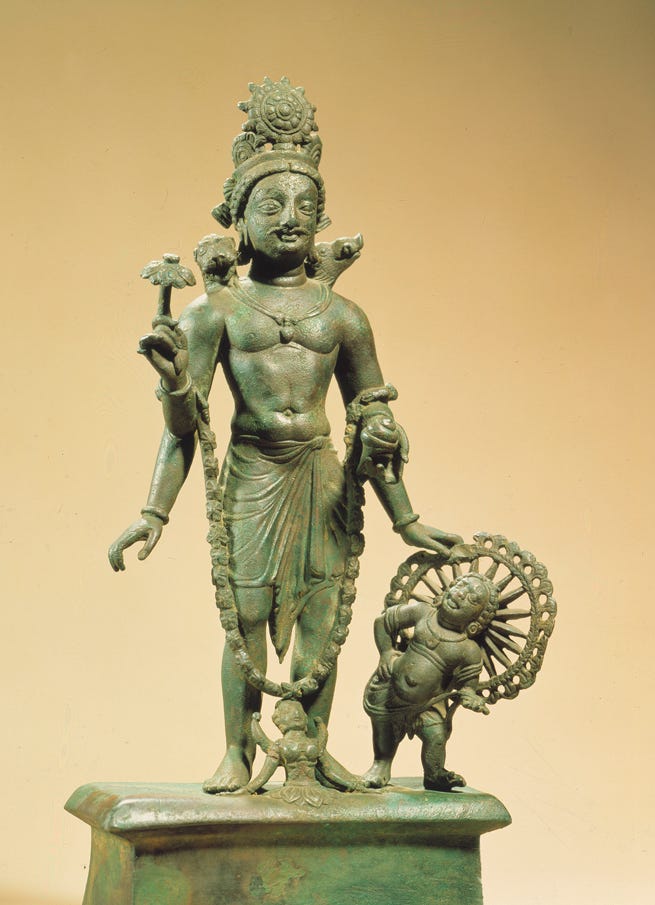
The above ornate bronze of Viṣṇu Vaikuṇṭha from the Kashmir valley displays a four-headed Vishnu standing in tribhanga pose on a rectangular pedestal. Viṣṇu is flanked by his personified attributes, Gada Devi to the right and Chakra-purusa to the left, both are bearing flywhisks. A tiny image of Bhū Devi is portrayed between Vishnu’s feet. The four heads of Viṣṇu are those of a placid human being in the front, a lion and boar on the sides and a ferocious being at the back. Adorned heavily with ornaments and a crown, deity places on set of hands upon the heads of Gada Devi and Chakrapurusa whereas the other set of hands holds the lotus and conch. Braided hair locks are spread over the shoulders and part of the hair is gathered up in a conical pile on top of the head. The dhoti seems to be tied around the thighs in a very stylistic manner. The eyes are inlaid with silver. The pedestal is provided with a spout to drain off fluids poured ritually over the image. The images of three-faced Viṣṇu of the Gupta period were expanded by an addition of a fourth head (Kapila-Rudra) to the rear during the 8th century A.D. in Kashmir. The flower garland around the image is a typical feature of Kashmir art. A similar image of Viṣṇu Vaikuntha is housed in the Lakṣmi-Nārāyaṇa temple at Chamba.
Narayana temple in Chamba.

From the time of the Ṛg Vēda, the idea of four directions is connotative of spacial and cosmic totality; Agni in Ṛg Vēda is four-faced because the god, as flaming fire, extends into all the directions on earth and possibly beyond. The significance of a four-fold nature was extended to the manifestations of Vāsudeva. The earliest reference to the caturvyūha doctrine occurs in the the Nārāyaṇīya of the Śāntiparva of the Mahābhārata, which enounces the basic tenets of the vyūhas (distinct from avatāras) in connection with the epiphany of the Supreme Nārāyaṇa; the divine manifestation is granted to the Sage Nārada on the White Island (Śvēta dvīpa). The Nārāyaṇīya could be regarded, therefore, as the foundational text of classical Hinduism, containing not only a well-developed theology of the Supreme Being Nārāyaṇa but the seeds of its iconography, ritual, and daily praxis.
Nārāyaṇa grants a vision of his universal self to Nārada because the latter, as a true bhakta, is with all his heart devoted solely to the Lord. The supernal Nārāyaṇa declares Himself to be of quadruple form. Bhīṣma narrates Nārāyaṇa’s speech to Nārada, wherein He discourses on his devotees, the nature of the One and how it is to be known; the process of cosmic dissolution; the emanation of the four vyūhas — Vāsudeva, Saṃkarṣaṇa, Pradyumna, and Aniruddha from him; his true nature and his manifestation before Nārada; all the beings contained in him; his different names; the cyclical creation from him; and his ten avatāras to uphold good and destroy evil; and, finally, on how, after having saved the earth, he will return to his own worlds.” (Mahābhārata, 12.326)
The vyūha doctrine later merged with the practice of the Bhāgavata sect, which worshiped Kṛṣṇa and four of his kinsmen as the ‘‘five heroes’’.


A description of the vyūhas of Viṣṇu from the Lakṣmi Tantra, that forms a part of the Pañcarātra āgama:
“From time to time a billion-billionth particle of ourselves, composed of consciousness, stirs into activity.
(That particle) which is known as the urge to create (sisṛkṣā) is in the form ‘I will create according to my liking’, whereupon I with that particle of myself, instantaneously evolved into pure creation (viśuddhādhvā).
as the brilliance of a diamond shines forth in all directions, so does my pure course (of creation) diffuses its rays in every direction.
Pure creation issues from my form of concentrated (absolute) knowledge, whose tranquility resembles cloudless sky or a still ocean.
Devoid of all activity, ever blissful, pure, all embracing and supreme, the primaeval jñāna becomes manifest as Saṃkarṣaṇa.
Aiśvarya (the divine attribute) is my sovereign power to create the universe without dependence on any factor outside myself. That is my form Pradyumna, the excellent person.
My śakti that is imminent, irresistible and which pervades the whole of this variegated universe is known as my Aniruddha form.
These resplendent, lotus-eyed Puruṣas (Pradyumna, Aniruddha and Saṃkarṣaṇa) are my forms manifesting the the divine attributes vijñāna, aiśvarya, and śakti, responsible for creation, maintenance and dissolution of creation respectively.
My primordial form that first stirs in me is Vāsudeva, who may be compared to an absolutely wave-less ocean or to a cloudless sky.
The manifestation of all my six divine attributes jñāna, śakti, bala, aiśvarya, vīrya, tejas in equal proportion is called Vāsudeva.”
More images

References:
- On the Symbolism of Three- and Four-Faced Viṣṇu Images: A Reconsideration of Evidence Adalbert J. Gail
- Shri Vishnudharmottara, a Text of Ancient Indian Arts By Priyabala Shah
- Early Vaiṣṇava Imagery: Caturvyūha and Variant Forms Doris Srinivasan
- Nārāyaṇīya: Translation, Introduction, and Philosophical Commentary, Vishwa Adluri
- Many heads, arms, and eyes: Origin, Meaning, and Form of Multiplicity in Indian Art by Doris Meth Srinivasan
- Lakshmi Tantra: A Pancharatra Text Sanjukta Gupta
______________________________________________________________
If you find value in my work, I hope you consider becoming a patron! Hindu Aesthetic requires a lot of time and effort and your support would mean that I can continue to bring you the best possible content. Link to my Patreon:
Curating Hindu art and knowledge - a testament to the glorious culture and heritage of a resilient civilisation. patreon.com/hinduaesthetic
Get an email whenever hindu aesthetic publishes.
Emails will be sent to bafremauxsoormally@yahoo.co.uk.
Curating Hindu art and knowledge - a testament to the glorious culture and heritage of a resilient civilisation. patreon.com/hinduaesthetic
The Hanuma-dhvaja or kapi-dhvaja, the monkey standard, was a widely known dhvaja in ancient india. According to the Mahābhārata, the kapi-dhvaja was created by Prajāpati after a long penance. It was borne by King Soma during his exploits over demons who then passed it to Varuṇa. Varuṇa gave it to…
Share your ideas with millions of readers.
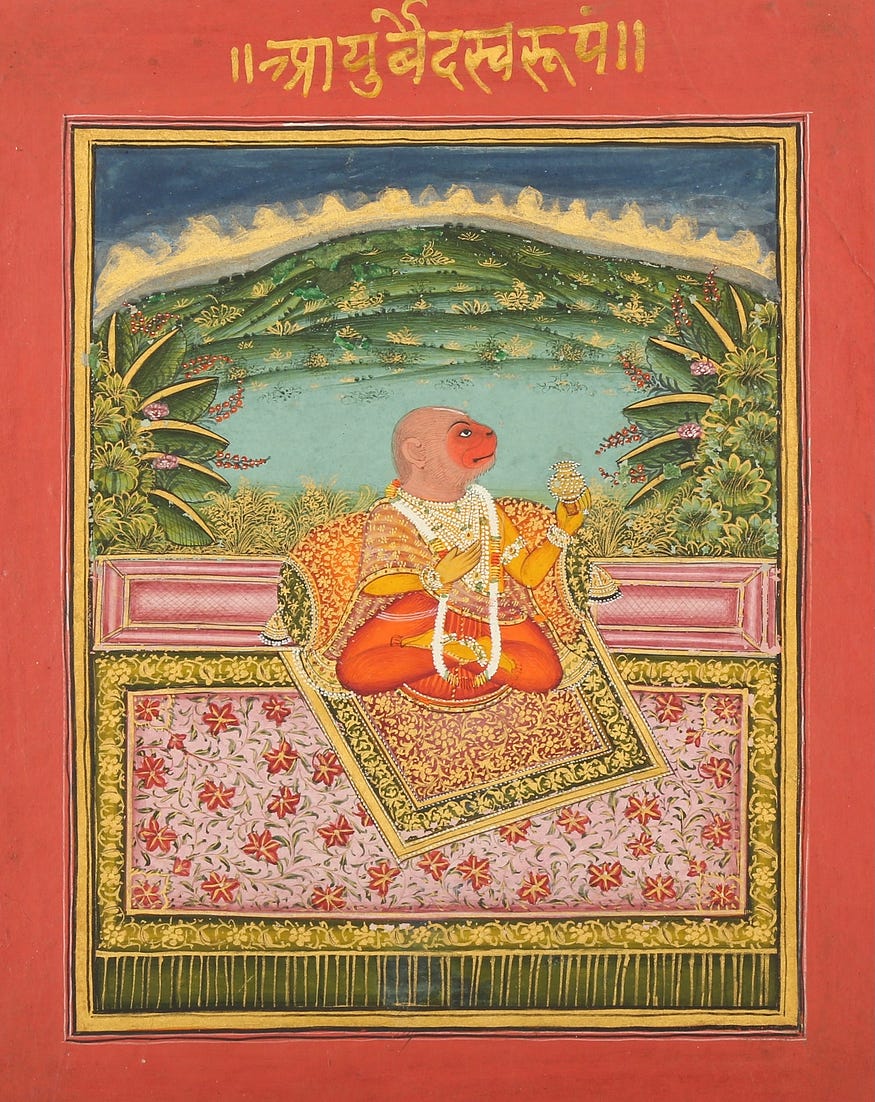
“lāya sa̐jīvani lakhana jiyāye
śrīraghubīra haraṣi ura lāye”
“Bringing the Mṛtasañjīvanī herb, You resuscitated Lakṣmaṇa. The auspicious Lord Rāma rejoiced and embraced You.” (Hanumān Cālīsa)
Hanumān is venerated as Āyurveda Svarūpa in reference to his quest for the rare Himalayan herb Mṛtasañjīvanī that heals all wounds. It is a sort…

The worship of footprints as a symbol of the deity is undoubtedly an ancient Indian practice. Though we see Viṣṇupāda worshipped more frequently than Śiva’s footprints (Śivapāda), texts confirm their existence, especially the Skanda Purāṇa, which describes the marking of Śiva’s sacred geography. In the Āvantya-khaṇḍa is described the implanting…
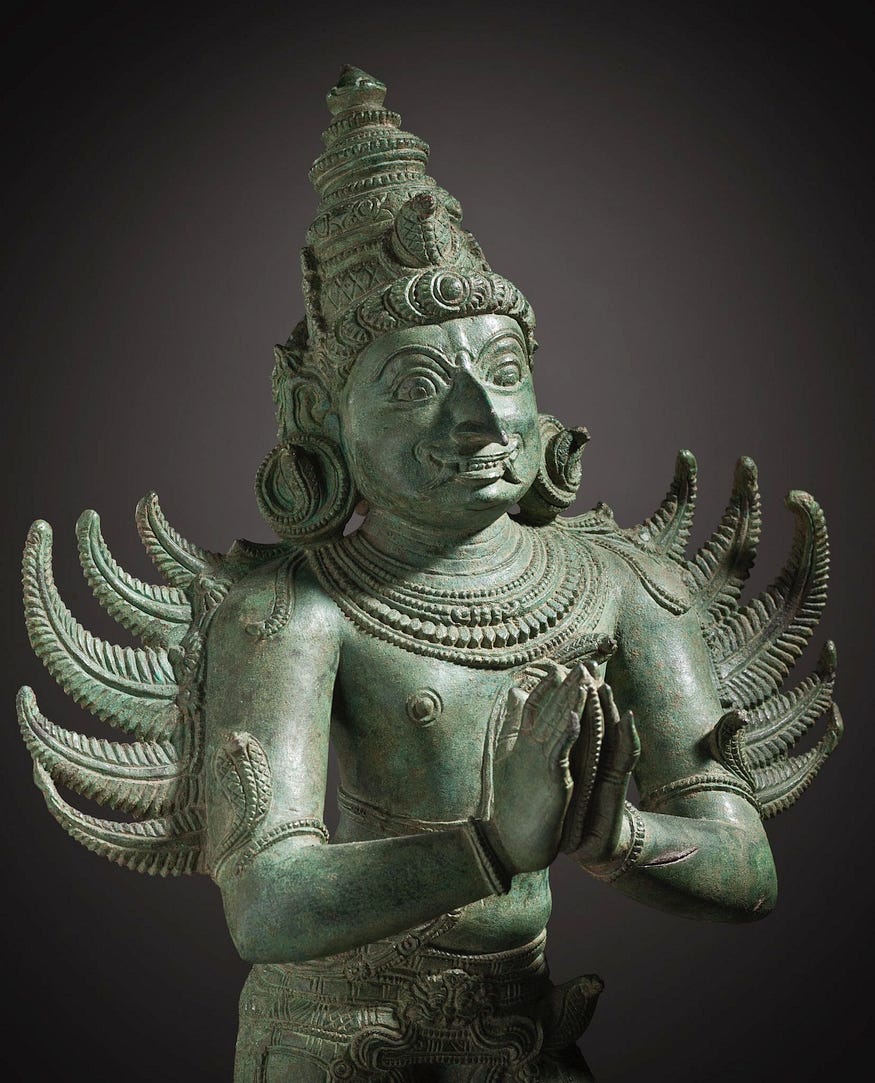
Śrīgaruḍadaṇḍakam was composed by Vedanta Desikan, 13th century Śri Vaiṣṇava philosopher and Sanskrit scholar when challenged by a snake charmer, who released poisonous snakes in order to test him. …
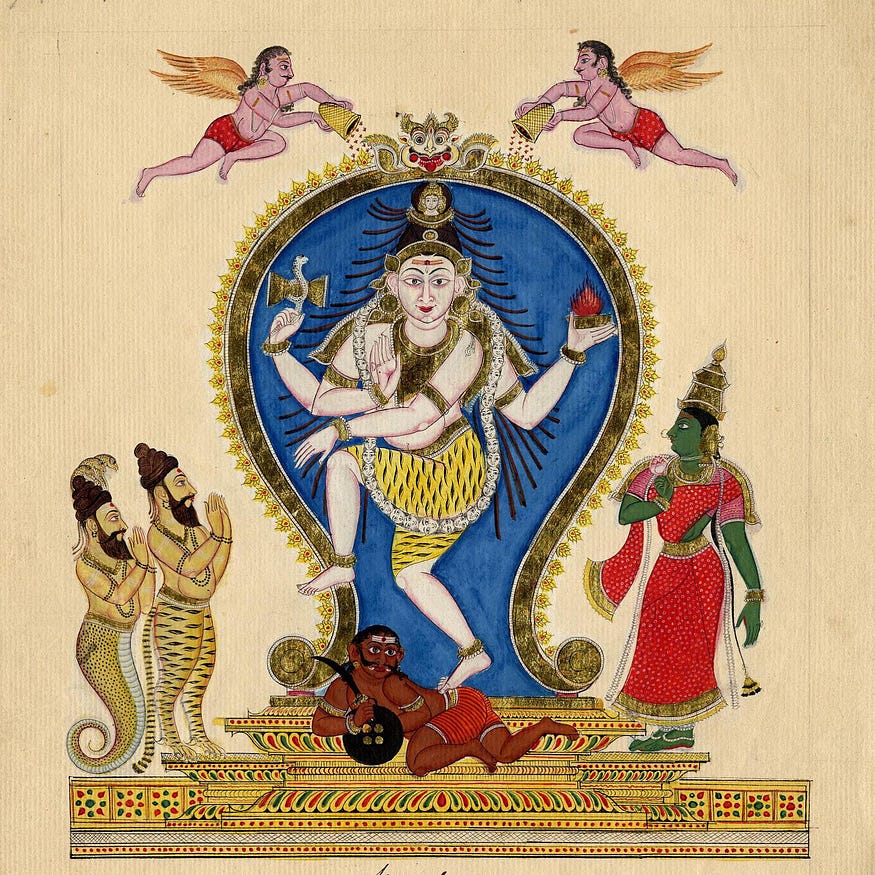
“The foot raised to kill the Moon,
at Dakṣa’s sacrifice,
the foot which sent Death to his death,
the foot which Nārāyaṇa and Brahmā
sought in vain to see,
the foot raised in dance
in Tillai’s Little Ampalam hall -
that is the foot which possesses us!”Appar (translated by…


