Beqaraar
Hai Koi - Sung by Muhammad Rafi & Suraiya
From the
film Shama Parwana (1954)
Music by Husanlal Bhagatram
Lyrics by Majrooh Sultanpuri
N.B. This was before Hindustani cinema sold out to Satanic Forces!
Sarah, my beautiful Mona Lisa, my son's wife.
"Eid
al-Adha 2016 began in the evening of Saturday,
September 10 and ended in the evening of Sunday, September 11"
The Soviet Judaics (non Semites) sacrificed my First-Born son Olyeg of my Russian wife in 1968 in the name of Marxism and Communism!
Shailah, the beautiful Mother of my First Grandson. [Gif removed as per request - 2 July 2020]
JEWIPEDIA or WICKEDPEDIA
Eid al-Adha (Arabic: عيد الأضحى ʿīd al-aḍḥā
GOD OR NO GOD, THE REAL SPIRIT BEHIND
EID-AL-ADHA!
A Godsend
Background "Festival of the Sacrifice"), also called the "Sacrifice
Feast" or "Bakr-Eid", is the second of two Muslim
holidays celebrated worldwide each year, and considered the holier of the
two.
Like always, in order to justify
the why of a noble charitable practice, that is to feed the needy, some
religious leaders had to invent a story, a fable, which in this case is quite
stupid and insulting to God, if there is such a God outside our imagination
and belief system, but the concept and the beliefs in it are real and have
guided millions to this very day making them better human beings as far as
Islam is concerned.
The
Old Testament has depicted Abraham as very stupid and cowardly, and who
even sold his wife to the pharaoh like one sells a prostitute. The whole matter revolves around the
obligation of the believer in a Merciful God to feed the poor or the needy with
one third of their food, while at the same time sharing another third amongst
themselves, and the remaining with relatives, friends, neighbours and
travellers.
Muhammad, my unique son and his wife Shailah.
"In the Islamic lunar calendar, Eid al-Adha falls on the 10th
day of Dhu al-Hijjah and lasts for four days until the 13th
day.[4]
In the international (Gregorian) calendar, the dates vary from year
to year drifting approximately 11 days earlier each year.
My little Princess Layana
Eid al-Adha is the latter of the two Eid holidays, the former being Eid
al-Fitr. The word "Eid" has been used by "Semitic"
speaking people, like Arabic, Canaanite, Phoenician, Aramaic, Syriac, Hebrew,
etc., to mean CELEBRATION, and it "appears once in Al-Ma'ida,
the fifth sura of the Quran, with the meaning "solemn festival".[5]"
My
other two Princesses, Aïshah and Jumaymah. [Photo removed as per request - 2 July 2020]
"Eid al-Adha celebrations start at the same time as the
annual Hajj in Mecca.
The Arabic term "festival of the sacrifice", ʿīd
al-aḍḥā / ʿīd ul-aḍḥā is borrowed into Indo-Aryan languages such as Urdu, Hindi, Bengali,
Gujarati, and Austronesian languages such as Malay
and Indonesian (the last often spelling it as Aidil
Adha or Idul Adha). Another Arabic word for "sacrifice" is
Qurbani
(Arabic:
قربان.) The Semitic root Q-R-B (Hebrew ק-ר-ב)
means "to be close to someone/something"; other words from the root include qarov, "close", and qerovim, "relatives."
The senses of root meaning "to offer" suggest that the act of
offering brings one closer to the receiver of the offering (here, God). The
same stem is found in Hebrew and for example in the Akkadian
language noun aqribtu "act of offering.
Eid al-Kabir, an Arabic term meaning "the Greater Eid" (the
"Lesser Eid" being Eid al-Fitr),[8] is
used in Yemen, Syria, and North Africa (Morocco, Algeria, Tunisia, Libya, and
Egypt). The term was borrowed directly into French as Aïd el-Kebir.
Translations of "Big Eid" or "Greater Eid" are used in
Pashto (لوی اختر Loy Axtar), Kashmiri
(Baed Eid), Urdu and Hindi (Baṛī Īd), Tamil
(Peru Nāl, "Great Day") and Malayalam (Bali
Perunnal, "Great Day of Sacrifice"). Albanian,
however, uses Bajram(i) i vogël or "the Lesser Eid" (as
opposed to Bajram i Madh, the "Greater Eid", for Eid al-Fitr)
as an alternative reference to Eid al-Adha.[citation needed]
The festival is also called "Bakr-Eid" in Urdu and Hindustani languages (بقر عید, baqr `īd),[9][better source needed]
stemming from the Arabic word al-Baqara meaning "The Cow", although some have
wrongly attributed it to the Urdu and Hindustani word bakrī, meaning
"goat", because of the tradition of sacrificing a goat in South Asia
on this festival. This term is also borrowed into other Indian languages, such
as Tamil Bakr `Īd Peru Nāl.[citation needed] Some names refer to the fact that the holiday occurs after the culmination
of the annual Hajj.
Such names are used in Malaysian and Indonesian (Hari Raya Haji
"Hajj celebration day",[10][11][12]Lebaran Haji, Lebaran Kaji. When this was not yet an official
feast in the Philippines, this was how it was called in Mindanao and
other predominantly Muslim areas. When it became a legal holiday in 2009, it
became officially known as Eid al-Adha. Some also reference it with local
language names like Kapistahan ng Pagsasakripisyo in Tagalog.
In Tamil it is called (Hajji Peru Nāl).[citation needed]
[Photograph removed as per request - 2 July 2020]
It's also known as Id ul Baqarah in Egypt, Saudi Arabia and in the
Middle East, as Eid è Qurbon in Iran, Kurban Bayramı ("the
Holiday of Sacrifice") in Turkey, Baqarah Eid in India, Pakistan
and Trinidad, Eid el-Kebir in Morocco, Tfaska Tamoqqart in the Berber
language of Jerba, Iduladha or Qurban in Singapore,
Malaysia, Indonesia and the Philippines, Qurbani Eid in Bangladesh, Bakr-Id
("Goat Eid") in parts of Pakistan and India and Tabaski or Tobaski
in Senegal and West Africa[10][11][12][13]
(most probably borrowed from the Serer
language — an ancient Serer religious festival[14][15][16][17][source needs
translation]), Babbar Sallah in Hausa
language and ciida gawraca in Somali.[citation needed] Eid al-Adha
has had other names outside the Muslim world. The name is often simply
translated into the local language, such as English Feast of the Sacrifice,
German Opferfest, Dutch Offerfeest, RomanianSărbătoarea Sacrificiului, and HungarianÁldozati ünnep. In Spanish it
is known as Fiesta del Cordero[18]
or Fiesta del Borrego[19]
(both meaning "festival of the lamb")."
SACRIFICE MY SON?
Possessed by the Devil and the love of money, my French wife threatened to kill our 2 year old son (SACRIFICE HIM TO SATAN!) and then kill herself!
I had to call the Police who sent a Brigadier to visit them and make sure they were both safe because I was working in Paris, some 70 kilometres away!
She almost succeeded by slowly killing us, and stealing our home, businesses, funds, and poisoning our lives thanks to her new "partner" Christopher Dean Harrington, a "Jehovah Witness" in 1997!
The other myth that Abraham would
allow himself to be bullied by his childless, aged and menopaused wife Sarah and
abandon his wife Hagar and first-son "baby" Ishmael (Isma'il) to die
in the desert of Arabia is pathetic. Other
myths were added to that pathetic story!
This totally fabricated story "is
known as the Akedah in Judaism (Binding of Isaac) and
originates in the Tora,
the first book of Moses (Genesis, Ch. 22). Their corrupted religion allowed them tp
practice human sacrifice.
See Holy Qur'ân, Sura 37 (As-Saaffat),
Ayat 100–112
In
short, there was NO HUMAN SACRIFICE, but just a sacrifice of personal wealth
for the needy!
Believers, men, women, children
and babies, wherever and whenever possible attend a congregation of
believers inside a building or in a large field (an Eidgah) to
celebrate the Eid act of worship, and perform certain rituals according to Muslim
Traditions, not necessarily according to Islam, and differing from country to
country, and culture to culture.
"The scholars differed concerning the ruling on Eid
prayers. There are three scholarly points of view:
That Eid
prayer is Fard Kifaya (communal obligation). This is the view of Abu
Hanifa.
That it
is Wajib on all Muslim men (a duty for each Muslim and is
obligatory for men); those who do not do it without an excuse are
considered sinners. This is the view of Ahmad ibn Hanbal, and was also narrated from
Abu Hanifa."
A variety of incantations are
practiced across the Muslim lands. The
most common is:
Allāhu akbar, Allāhu akbar
اللهأكبراللهأكبر
lā ilāha illā-Allāh
لاإلهإلاالله
Wallāhu akbar, Allāhu akbar
واللهأكبراللهأكبر
walillāhi l-ḥamdu
وللهالحمد
Allah is the Greatest, Allah is the Greatest!
There is no god but Allah!
Allah is the Greatest, Allah is the Greatest!
And to Allah goes all praise!
In order to provide the required food,
it was the Tradition, even before perfected Islam to sacrifice animals. This sacrifice is called Corban in the Bible,
and aḍḥiya in Arabic (Arabic:
أضحية). It is also known by
the Perso-Arabic term qurbāni. What is disgusting and utterly revolting (IF
TRUE!) is the slaughter of "more
than 100 million animals in only two days of Eid. In Pakistan alone nearly ten
million animals are slaughtered on Eid days costing over US$3 billion.[31]"
What I personally know to be true since my teenager years is that during the
Annual Pilgrimage or HAJJ, millions of animals are cruelly slaughtered and
bulldozed into the ground by the CIA-SAUDIS (Crypto-Jews) (in OCCUPIED ARABIA) and by the stupid,
fanatical and barbaric Pilgrims.
Horror at the Hajj: At least 700 people are crushed to death
and hundreds injured in stampede during Muslim pilgrimage in Mecca just
two weeks after crane collapse killed 109
WARNING: GRAPHIC CONTENT
Rescue under way after stampede in Mina where two million pilgrims were taking part in the last major rite of Hajj
Massive crowds gather in Mecca every year with Islam requiring all Muslims to perform Hajj once in their lifetime
Saudi officials use 100,000 police and large numbers of stewards to ensure safety and help those who lose their way
Comes weeks after crane toppled into the Grand Mosque killing more than 100 people and injuring hundreds more
At
least 717 people have been crushed to death and hundreds of others hurt
in a stampede of pilgrims in one of the worst incidents in years to
hit the Muslim Hajj in Saudi Arabia.
Saudi
Arabia's civil defence service said rescue operations were under way
after the stampede in Mina, where almost two million pilgrims were
taking part in the last major rite of the Hajj.
Pictures
showed a horrific scene, with scores of bodies – the men dressed in the
simple terry cloth garments worn during Hajj – lying amid crushed
wheelchairs and water bottles along a sunbaked street.
Survivors
assessed the scene from the top of roadside stalls near white tents as
rescue workers in orange and yellow vests combed the area, placing
victims on stretchers and desperately trying to resuscitate others.
The
disaster comes just two weeks after a construction crane collapsed at
Mecca's Grand Mosque, Islam's holiest site, killing 109 people.
Scroll down for video
+57
Saudi medics stand near bodies of Hajj pilgrims at the site where
hundreds were killed in a stampede in Mina, near the holy city of Mecca
+57
Rescue workers in orange and yellow
vests comb the area, placing victims on stretchers and desperately
trying to resuscitate others
+57
Pilgrims gather around victims of a
stampede which has killed hundreds of Muslims during the annual hajj
pilgrimage in Mina, Saudi Arabia
+57
Hajj horror: The stampede occurred in a
morning surge of pilgrims at the intersection of streets 204 and 223 as
the faithful were making their way toward a large structure overlooking
the columns, according to the Saudi civil defense directorate
+57
Saudi emergency personnel stand near
bodies of Hajj pilgrims at the site where at least 717 were killed and
hundreds wounded in a stampede
+57
Survivors assess the scene from the
top of roadside stalls near white tents as rescue workers in orange and
yellow vests comb the area
+57
Bodies of hundreds of dead and injured
pilgrims lie strewn across the floor after they were caught up in a
horrific stampede in Saudi Arabia
Pilgrims
had converged on Mina just outside Mecca on Thursday to throw pebbles
at one of three walls representing Satan, the symbolic 'stoning of the
devil' that marks the last day of the event.
The
civil defence service said that it was still counting the dead, who
included pilgrims from different countries and that at least 863 people
had also been hurt.
Iran said at least 43 of its citizens were dead and accused Saudi Arabia of safety errors that caused the accident.
But a Saudi minister blamed the pilgrims themselves, saying they had not followed the rules laid out by authorities.
'Many
pilgrims move without respecting the timetables' set for the Hajj,
Health Minister Khaled al-Falih told El-Ekhbariya television.
'If
the pilgrims had followed instructions, this type of accident could
have been avoided,' he said, vowing a 'rapid and transparent'
investigation.
The
stampede began at around 9am (6am GMT), shortly after the civil defence
service said on Twitter it was dealing with a 'crowding' incident in
Mina, about three miles from Mecca.
A Sudanese pilgrim in Mina said this year's Hajj was the most poorly organised of four he had attended.
'People were already dehydrated and fainting' before the stampede, said the pilgrim who declined to be named.
+57
The stampede occurred at the
intersection of Street 204 and Street 223, when it is believed two waves
of pilgrims travelling in different directions collided. On Day one of
the Hajj, pilgrims walk to Mina where they spend the night. On Day two,
they climb nearby Mount Arafat, where Mohammed gave his final sermon. On
Day three (today), pilgrims celebrate Eid al-Adha with the stoning of
three pillars at Jamarat, which represents Satan. On Day four they
return to Mecca for the final tawaf, which involves circling the Kaaba,
at the centre of the Grand Mosque
+57
Roughly two million Muslims take part
in the annual pilgrimage to Mecca, in Saudi Arabia, every year. The
civil defence service said that it was still counting the dead, who
included pilgrims from different countries and that at least 863 people
had also been hurt
Emergency service workers attend to
victims crushed in the stampede in Mina, Saudi Arabia, during the annual
Hajj pilgrimage on Thursday
+57
+57
More than
220 rescue vehicles and some 4,000 members of the emergency services
were deployed soon after the stampede to try to ease the congestion and
provide alternative exit routes
+57
Muslim pilgrims arrive to throw
pebbles at pillars during the Jamarat ritual, representing the stoning
of Satan, in Mina, near the holy city of Mecca
+57
Hundreds of thousands of Muslim
pilgrims make their way to cast stones at a pillar symbolising the
stoning of Satan, in the last rite of the annual Hajj, on the first day
of Eid al-Adha
+57
The stampede began at around 9am (6am
GMT), shortly after the civil defence service said on Twitter it was
dealing with a 'crowding' incident in Mina, about three miles from Mecca
+57
Saudi emergency personnel and Hajj
pilgrims push a wounded person in a wheelchair at the site where
hundreds were killed in a stampede
+57
Investigation: Iran said at least 43
of its citizens were dead and accused Saudi Arabia of safety errors that
caused the accident
+57
A Sudanese pilgrim in Mina said this
year's Hajj was the most poorly organised of four he had attended, with
people 'tripping over each other'
+57
Rescue workers treat a pilgrim after hundreds of people were crushed to death and hundreds hurt in a stampede in Saudi Arabia
+57
A medic performs CPR on a Muslim after
a stampede killed and injured hundreds of pilgrims in the holy city of
Mina during the Hajj pilgrimage
+57
Terrifying: Pictures and video
revealed a horrific scene, with scores of bodies – the men dressed in
the simple terry cloth garments worn during Hajj – lying amid crushed
wheelchairs and water bottles along a sunbaked street
People
'were tripping all over each other', he said, adding that a Saudi
companion had warned him that 'something was going to happen'.
The
tragedy struck during a morning surge of pilgrims at the intersection
of streets 204 and 223 as the faithful were making their way toward a
large structure overlooking the columns, according to the civil defence
directorate.
The
multi-storey structure, known as Jamarat Bridge, is designed to ease
the pressure of the crowds and prevent pilgrims from being trampled.
Na’eem Raza, from Glasgow, was making the pilgrimage for the 17th time this year.
The television presenter said that if he had followed his usual Hajj routine, he would likely have been among those injured.
‘I
changed my order of performing the Hajj rituals by making Tawaf Al
Ifadah last night first, then heading to the Media compound in Jamaraat
before Fajr and intended to carry out the stoning later today.’
He
added: ‘Just found out that over 200 people have died in a stampede at
the Jamaraat during a time when I would have been in the same locality
had I performed my rituals as I usually do.’
Mr
Raza said that the streets had been closed to allow ambulances and
doctors in to help the injured, while bodies were being removed from the
scene.
Two
survivors said the disaster began when one wave of pilgrims found
themselves heading into a mass of people going in another direction.
‘I
saw someone trip over someone in a wheelchair and several people
tripping over him,’ one of the survivors, Abdullah Lotfy, 44, from Egypt
told Associated Press.
The stampede began at around 9am (6am
GMT) shortly after the civil defence service said on Twitter it was
dealing with a 'crowding' incident
+57
Gruesome clear-up: The civil defence
service said that it was still counting the dead, who included pilgrims
from different countries and that at least 863 people had also been hurt
‘People were climbing over one another just to breathe. It was like a wave. You go forward and suddenly you go back.’
Mr Lotfy added that having two flows of pilgrims interacting in this way should never have happened.
‘There was no preparation. What happened was more than they were ready for,’ he said, of the Saudi authorities.
The Interior Ministry said that the crush appears to have been caused by two waves of pilgrims meeting at the intersection.
The
ministry’s spokesman, Maj. Gen. Mansour al-Turki, said high
temperatures and the fatigue of the pilgrims may also have been factors
in the disaster.
He
said there was no indication that authorities were to blame for the
event, adding that ‘unfortunately, these incidents happen in a moment’.
Helicopters were flying overhead and ambulances were rushing the injured to hospital, AFP reporters at the scene said.
At one hospital, a steady stream of ambulances discharged pilgrims on stretchers.
A hospital official said the incident happened outside the Jamarat Bridge structure, where the stoning takes place.
+57
Health workers help the wounded near
Saudi Arabia's holy Muslim city of Mecca after the stampede killed and
injured hundreds of pilgrims
+57
Hazard: The stampede was the deadliest
disaster at the Hajj since 2006, when more than 360 pilgrims were
killed in a crush in the same area
A
group of pilgrims leaving the area collided with another group that was
either moving in the opposite direction or camped outside, the official
said.
It
is not known if any of the dead are British but the Foreign &
Commonwealth Office (FCO) has said it is in contact with the local
authorities.
Prime Minister David Cameron tweeted: 'My thoughts and prayers are with the families of those killed at the Hajj pilgrimage.'
The
world's 1.5billion Muslims were marking Eid al-Adha, the Feast of
Sacrifice, the most important holiday of the Islamic calendar.
The Hajj is among the five pillars of Islam and every capable Muslim must perform it at least once in a lifetime.
In
the past, the pilgrimage was for years marred by stampedes and fires,
but it had been largely incident-free for nearly a decade following
safety improvements.
In January 2006, 364 pilgrims were killed in a stampede during the stoning ritual in Mina.
Thursday's
ritual was taking place at a five-storey structure known as the Jamarat
Bridge, which cost more than $1billion to build and was used during
earlier pilgrimages.
Almost one kilometre long, it resembles a parking garage and allows 300,000 pilgrims an hour to carry out the ritual.
En masse: Nearly two million Muslims
make their way to cast stones at a pillar symbolising the stoning of
Satan in a ritual called Jamarat
+57
Disaster: The tragedy happened as
pilgrims converged on Mina just outside Mecca to throw pebbles (above)
at one of three walls representing Satan, the symbolic 'stoning of the
devil' that marks the last day of the event
+57
The faithful had gathered until dawn
on Thursday at nearby Muzdalifah where they chose their pebbles and
stored them in empty water bottles
+57
Disaster: The Hajj tragedy comes just
two weeks after a crane toppled into Mecca's Grand Mosque, killing more
than 100 people (above)
+57
Struck before evening prayers:
Pictures on social media show the scale of crane collapse casualties
with bodies strewn across the mosque
The
faithful had gathered until dawn Thursday at nearby Muzdalifah where
they chose their pebbles and stored them in empty water bottles.
Yesterday,
they had spent a day of prayer on a vast Saudi plain and Mount Arafat, a
rocky hill about 10 kilometres from Mina, for the peak of the Hajj
pilgrimage.
The
flow of exhausted pilgrims was so big that Saudi security forces had to
form a human chain along the roads of the vast Arafat plain while a
jets of water were sprayed on the huge crowds to keep them cool amid
searing heat.
Many
of the faithful from around the globe camped at the foot of Mount
Arafat where they slept and prayed – despite the scorching sun – at the
spot where Prophet Mohammed is believed to have given his final sermon.
Carrying
colourful umbrellas, they walked from dawn in massive crowds towards
the slippery, rocky hill which is also known as Mount Mercy.
Here they believe Mohammed gave his final sermon 14 centuries ago after leading his followers on Hajj.
Many
reached Arafat by bus while some walked from the holy city of Mecca
about nine miles away. Along the way, volunteers handed out boxes of
food and cold water bottles.
For many pilgrims, Hajj is the spiritual highlight of their lives.
'We
feel blessed. I got goosebumps, a feeling that cannot be explained,
when reaching the top of the mountain,' said Ruhaima Emma, a 26-year-old
Filipina pilgrim, who said she has been 'praying for a good life for
everyone'.
+57
As far as the eye can see: A view of
the camp city at Mina, near the holy city of Mecca, where hundreds were
killed in the stampede
+57
Tens of thousands of Muslims defied the scorching sun to perform prayers in Arafat during the annual Hajj pilgrimage yesterday
+57
On the move: Millions of Muslim
pilgrims set off before dawn yesterday to make their way to a day of
prayer at the foot of Mount Arafat
+57
Water vapour sprays down from metal
pipes to cool the crowds of tens of thousands of Muslims during their
day of prayers at Arafat yesterday
+57
Global gathering: They walked from dawn in massive crowds towards the slippery, rocky hill which is also known as Mount Mercy
+57
Many of the faithful from around the
globe camped at the foot of Mount Arafat where they slept and prayed
despite the scorching sun at the spot where Prophet Mohammed is believed
to have given his final sermon
+57
Taking in the view: Huge numbers were
up and about before first light ahead of a day of prayer on the Plain of
Arafat - nine miles from Mecca
+57
Many reached Arafat by bus while some
walked from the holy city of Mecca about nine miles away. Along the way,
volunteers handed out boxes of food and cold water bottles
+57
Many carried umbrellas to shield
themselves from the sun as they performed their prayers this morning
with hundreds of thousands of others
+57
A wagon filled with fruit is stationed in the middle of a huge crowd of pilgrims as they worship at the foot of Mount Arafat
+57
+57
Many of the
exhausted pilgrims slept at the foot of Mount Arafat (right) after
walking the nine miles from Mecca with thousands of others (left)
+57
Pilgrims believe that thi was the spot where Mohammed gave his final sermon 14 centuries ago after leading his followers on Hajj
+57
Crowds crammed together as they prepared for a day of worship. Many were brought in by bus but thousands walked from Mecca
For
Akram Ghannam, 45, from war-torn Syria, being in Arafat is a 'feeling
that cannot be described. I pray to God for the victory of all those who
are oppressed.'
Other
pilgrims arrived from nearby Mina using the elevated Mashair Railway
linking the holy sites of Arafat, Muzdalifah and Mina, a tent city where
many pilgrims spent Tuesday night.
This
year's gathering is about the same size as last year's, with 1.4
million foreign pilgrims joining hundreds of thousands of Saudis and
residents of the kingdom.
Islam
requires all able-bodied Muslims to perform the Hajj once in a lifetime
– and each year huge crowds are drawn to Mecca to carry out a series of
rituals and prayers aimed at erasing past sins.
Pictures
yesterday show newly-arrived pilgrims circling the Kaaba, the black
cube-shaped structure in Mecca's Grand Mosque toward which all Muslims
pray.
+57
This year's gathering is about the
same size as last year's, with 1.4 million foreign pilgrims joining
hundreds of thousands of Saudis and residents of the kingdom
+57
A day to remember: Two pilgrims used a selfie stick as they pictured themselves near Mount Arafat before dawn this morning
+57
After sunset on Wednesday they will
move to Muzdalifah where there they will gather pebbles for a symbolic
stoning of the devil ritual
+57
For many pilgrims, it is the spiritual
highlight of their lives. Islam requires all able-bodied Muslims to
perform the Hajj once in a lifetime
Saudi
authorities deploy 100,000 police and vast numbers of stewards to
ensure safety and help those who lose their way. They have also invested
in expensive infrastructure, including a new urban railway, to ferry
pilgrims around safely.
It comes just weeks after a crane toppled into Mecca's Grand Mosque killing more than 100 people and injuring hundreds more.
The
crane which collapsed during a thunderstorm was one of several working
on a multi-billion-dollar expansion of the mosque to accommodate
mounting numbers of faithful.
Despite the tragedy, Saudi officials quickly vowed that the Hajj to Mecca would go ahead with thousands descending on the city.
+57
Global gathering: Each year huge
crowds are drawn to Mecca to carry out a series of rituals and prayers
aimed at erasing past sins
+57
Pictures show pilgrims circling the Kaaba, the black cube-shaped structure in Mecca's Grand Mosque toward which all Muslims pray
+57
Once in a lifetime: Saudi officials
have also invested in expensive infrastructure, including a new urban
railway, to ferry pilgrims around safely
During
the Hajj, pilgrims shed symbols of worldly materialism, entering a
state known as 'ihram' - women forgo makeup and perfume for loose fitted
clothing and a head-covering while men wear seamless terry cloth white
garments.
The
pilgrimage is among the five main pillars of Islam, which also include
belief in the oneness of God and the Prophet Muhammad as his final
messenger, five daily prayers facing toward the Kaaba, annual charity
and fasting during the month of Ramadan.
Muslims
believe the Hajj traces the paths of the Prophets Abraham, Ishmael and
Muhammad. Pilgrims start the Hajj in Mecca, before heading to the nearby
tent city of Mina, five kilometers (three miles) away.
+57
During the Hajj, pilgrims shed symbols
of worldly materialism, entering a state known as 'ihram' - women forgo
makeup and perfume for loose fitted clothing and a head-covering while
men wear seamless terry cloth white garments
+57
A Muslim pilgrim cries while praying
at the Kaaba, the cubic building at the Grand Mosque in the Muslim holy
city of Mecca, during the annual Pilgrimage, known as Hajj
+57
A Muslim pilgrim uses an electric
wheelchair to circle the Kaaba. The Hajj requires physical perseverance,
finances and a coveted Hajj visa, which is limited to
country-by-country quotas to manage crowd safety
In
Mecca, they circle the Kaaba counterclockwise seven times, and also
re-enact the path of Hagar, the wife of the patriarch Abraham, who
Muslims believe ran between two hills searching for water for her dying
young son.
Tradition
holds that God then brought forth a spring of water that runs until
this day and which Muslims drink from during the Hajj.
Since
arriving to Mecca over the past several weeks, hundreds of thousands
have chanted, 'Labayk Allahuma Labayk,' or 'Here I am, God, answering
your call. Here I am.'
Many
prayed for their deceased kin. Sadi Zawya, who lost his wife earlier
year and is now raising his five children on his own was among the sea
of people.
Arriving
from Egypt, 62-year-old Hoda Darahim said her 35 year-old daughter died
this year, and that she is now raising her two grandchildren, relying
on financial help from her older sons and the small government pension
she receives.
+57
In Mecca, they circle the Kaaba
counterclockwise seven times, and also re-enact the path of Hagar, the
wife of the patriarch Abraham, who Muslims believe ran between two hills
searching for water for her dying young son
+57
The main day of Hajj this year falls
on Wednesday, when between 2 to 3 million pilgrims gather in a valley
called Arafat, packed shoulder to shoulder in prayer
+57
Muslim pilgrims pray while touching
the Kaaba. Saudi authorities deploy 100,000 police and vast numbers of
stewards to ensure safety and help those who lose their way
'Her dream was to perform the Hajj,' Darahim said of her daughter. 'So I am fulfilling her wish.'
Moussa
bin Abdullah Butu, a 38-year-old artist from Nigeria, said this will be
his third Hajj but an especially challenging one since he lost his
two-year old son, Abdullah, to a long illness earlier this year. 'In the
white ihram, the rich man and the poor, we are all together,' he said.
The
Hajj requires physical perseverance, finances and a coveted Hajj visa,
which is limited to country-by-country quotas to manage crowd safety.
Butu said he was very grateful for his visa and the opportunity to once
again perform the hajj.
'I know that I am one of the people that Allah chose ... I am one of the people Allah called this year,' Butu said.
The
main day of Hajj this year falls on Wednesday, when between 2 to 3
million pilgrims gather in a valley called Arafat, packed shoulder to
shoulder in prayer.
It
is at Arafat where the Prophet Muhammad delivered his final sermon some
1,400 years ago, calling for equality and unity among Muslims.
STAMPEDES, FALLING CRANES AND COLLAPSED BUILDINGS: HOW THOUSANDS HAVE DIED ON THE HAJJ PILGRIMAGE
Every
year, millions of Muslims converge on the Saudi holy cities of Mecca
and Medina for the annual Hajj pilgrimage, with the massive ceremonies
representing a major security and logistical challenge for the kingdom's
authorities.
On
occasion, the Hajj and events surrounding it have been marred by
accidents and tragedies, such as today's stampede near Mecca.
Here's a look at some deadly hajj-related incidents:
2015:
At least 107 people are killed and scores wounded when a crane
collapses in bad weather, crashing onto the Grand Mosque in Mecca,
Islam's holiest site.
2006: More
than 360 pilgrims are killed in a stampede at the desert plain of Mina,
near Mecca, where pilgrims carry out a symbolic stoning of the devil by
throwing pebbles against three stone walls.
The
day before the Hajj began, an eight-story building being used as a
hostel near the Grand Mosque in Mecca collapsed, killing at least 73
people.
2004: A crush of pilgrims at Mina kills 244 pilgrims and injures hundreds on the final day of the hajj ceremonies.
2001: A stampede at Mina during the final day of the pilgrimage ceremonies kills 35 Hajj pilgrims.
1998:
About 180 pilgrims are trampled to death in panic after several of them
fell off an overpass during the final stoning ritual at Mina.
1997:
At least 340 pilgrims are killed in a fire at the tent city of Mina as
the blaze was aided by high winds. More than 1,500 were injured.
1994: Some 270 pilgrims are killed in a stampede during the stoning ritual at Mina.
1990:
The worst hajj-related tragedy claims the lives of 1,426 pilgrims in a
stampede in an overcrowded pedestrian tunnel leading to holy sites in
Mecca.
Published on Friday, 25 September 2015 05:29 | Written by PressTV | |
The head of Iran’s Hajj and Pilgrimage Organization says at
least 1,300 people have been killed in a crush during Hajj pilgrimage
rituals outside Mecca.
Sa’eed Ohadi said on Thursday that at least 125 Iranian nationals were among those killed in the fatal stampede.
He added that the overall death toll is expected to exceed 1,500.
This as Saudi authorities say at least 717 people have been killed and nearly 863 others injured in the crush.
According to Saudi disaster officials, the incident occurred in Mina,
near Mecca, at 9 am local time (0600 GMT) after two large masses of
pilgrims coming down streets 204 and 223 fused together.
The incident took place as people were heading to participate in the symbolic stoning of Satan.
Over 220 ambulances and 4,000 rescue workers have reportedly been sent to the location.
“Work is underway to separate large groups of people and direct pilgrims to alternative routes,” the Saudi Civil Defense said.
During a meeting with senior officials responsible for the
pilgrimage in Mina, Prince Mohammed bin Nayef, who heads the Saudi hajj
committee, ordered an investigation into the deadly stampede.
Saudi blames pilgrims for tragedy
Saudi Arabia's health minister blamed the pilgrims for the deadly
incident, saying the tragedy would not have happened if they "had
followed instructions."
"Many pilgrims move without respecting the timetables" established by
authorities, Khaled al-Falih said, adding that this is the "principal
reason for this type of accident," El-Ekhbariya television reported.
"If the pilgrims had followed instructions, this type of accident could have been avoided," he said. ‘Saudi authorities responsible’
Hossein Amir-Abdollahian, Iran’s deputy foreign minister for Arab and
African affairs, said the Iranian Embassy in Saudi Arabia, the
Consulate and all other relevant organizations are actively working to
determine the fate of the Iranian victims of the Thursday incident.
Amir-Abdollahian held the Saudi authorities responsible for the
deadly incident, and said they should promptly act to manage the crisis.
“The imprudence on the part of relevant Saudi authorities to provide security for the pilgrims cannot be overlooked,” he said.
Amir-Abdollahian said the Saudi charge d'affaires has been summoned to the foreign ministry in Tehran over the fatal incident.
He added that a special commission has been set up by the Islamic
Republic to follow up on the case of the Iranian pilgrims in Mina.
A file picture taken on October 4,
2014 shows Muslim pilgrims arriving to throw pebbles at pillars during
the “Jamarat” ritual, the stoning of Satan, in Mina near the holy city
of Mecca. (Photo by AFP)
Some two million people are currently in Mecca for this year’s Hajj pilgrimage.
Some 360 pilgrims lost their lives during the same ritual in Mina back in January 2006
This comes days after a massive construction crane collapsed into
Mecca’s Grand Mosque, killing more than 100 people and leaving over 200
others wounded.
Muslim pilgrims walk past a crane
that collapsed the day before at the Grand Mosque in Saudi Arabia’s holy
Muslim city of Mecca, September 12, 2015. (Photo by AFP)
Separately, on September 21, a fire at a 15-story hotel in Mecca
forced the evacuation of some 1,500 people. A fire also broke out at
another hotel in the city days earlier, which left a number of
foreigners injured.
N.B. Those fools throw stones at a fictitious Satan while once home they collaborate with the real SATANS!
almassari <almassari@gmail.com>
To
almassari
Today at 10:00 AM
It’s Time to Break With Saudi Arabia’s ‘Kingdom of Horrors’
Posted on Sep 15, 2015
By Stanley Heller
Boys play amid the rubble of a house destroyed by a Saudi-led airstrike in Sanaa, Yemen. (Hani Mohammed / AP)
Saudi King Salman decided that a 10-vehicle motorcade in Washington, D.C., was too small for his needs, so his people rented 400 black Mercedes S-class automobiles
to make it bigger. There was no place to put them all, so the White
House housed them at Joint Base Andrews in Maryland until they were
needed. Wall Street Journal correspondent Carol Lee snapped a picture.
Salman was in D.C. earlier this month for a meeting with President
Obama. To house his retinue, he rented the entire Four Seasons hotel in
Georgetown. The lavish hotel evidently wasn’t decorated up to his
standards, so gold furniture and red carpets had to be wheeled in to spruce it up.
Salman
does live large. At the end of July he vacationed on the French Riviera
at his royal villa in Vallauris. The public beach was fenced off for
the occasion and a temporary elevator built to bring the 79-year-old
ruler down to the sand. As big as the mansion was, it couldn’t contain
his entire retinue. Forbes reported that the 1,000-strong collection of officials, aides, “courtiers, hangers-on, and wannabes” had to be housed elsewhere.
In
Yemen, where the monumental vanity of the Saudi regime caused it to
interfere and invade, conditions are far less opulent. UNICEF said in
August that 10 million children need urgent humanitarian assistance.
“Ten million children” is an abstraction, hard to understand. Instead
think about one child crying all night in pain or hunger and multiply
the sound 10 million times.
What a collection of heroes
the Saudis have gathered to make war on Yemenis! It includes Persian
Gulf monarchs whose construction and domestic work is done under
conditions of near slavery,
the Egyptian dictator who holds the one-day record for slaughter at a
sit-in and the Sudanese president whose travel options are limited
because he’s under indictment for genocide and crimes against humanity
(think Darfur). Let’s not leave out the U.S president, who has kill
notches on his Nobel Peace Prize for missions ranging from Libya to
Pakistan.
As Barack Obama met the Saudi king, scores of
protesters stood in front of the White House with signs and banners.
Among them was a man in striped prison garb with a King Salman mask. The
activists were mostly Yemenis residing in the U.S and members of the
anti-war group Code Pink. Some had signs displaying the hashtag
#KefayaWar, meaning “Enough War.” One photo shows the man masked as
Salman giving a mock flogging, a favorite regime punishment. In June,
blogger Raif Badawi’s 1,000-lash sentence was upheld by the Saudi Supreme Court. (My interview with Medea Benjamin of Code Pink about the weekend protests are on YouTube.)
The demonstration took place at a time when an effort has started to end the 70-year U.S.-Saudi alliance. A new website
was unveiled with that demand on its home page. The initial sponsors of
the campaign are the Institute for Gulf Affairs, Code Pink,
Massachusetts Peace Action and the Middle East Crisis Committee (which I
chair). The site links to a simple petition that says: “The U.S. has
spent trillions on military forces in the Persian Gulf. Washington
supports tyrannical regimes, wars and cruel occupations without making
us safe. Close the U.S. bases and bring the fleet home NOW.”
That
phrase “spent trillions” may be surprising. It’s well known that the
U.S. sells the regime immense amounts of weapons. Saudi Foreign Minister
Adel al-Jubeir told Reuters that Obama and Salman had discussed
“fast-tracking of the release of American military technology and
weapons systems” at their White House conclave. Arms sales bring in
money to the U.S. (or at least to merchants of death who own U.S.
weapons factories). However, there’s also the cost to U.S. taxpayers that for some reason is rarely mentioned. Back in 2011, Princeton University professor Roger Stern estimated that since the time of Jimmy Carter the U.S. had spent more than $8 trillion on military measures in the Gulf. An earlier study
by the University of California at Davis said that if there was no oil
in the Persian Gulf, “defense expenditures might be reduced in the long
run by roughly $27-$73 billion per year [in 2004 dollars].” Military
bases, soldiers, sailors, contractors, weapons system, fleets,
CENTCOM—they’re all financed by a flood of dollars. Without the
Saudi-U.S. alliance, there could be an enormous peace dividend.
Yemen
is the most obvious location of Saudi troublemaking, but its
money-fueled ambitions are regionwide and beyond. It supports the most
extreme sectarian forces
in Syria and the thousands of volunteers who rally to their call. At a
crucial moment after the 2013 Egyptian coup led by Gen. Abdel-Fattah
el-Sissi—when Western nations temporarily cut off funding—the Saudis
gave the general a cool $12 billion
in aid. They sent tanks into Bahrain in 2011 to help the Sunni king
there continue to oppress the majority Shiites. In 2010 The Times of
London reported that the Saudi air defense system had practiced
procedures to allow Israeli jets free passage over the Saudi heartland
in order to blitzkrieg Iran. The Jerusalem Post reported
on the claim with the headline “Saudi airspace open for Iran attack.”
Saudi plans go beyond the Middle East, however. The kingdom’s funding
for Wahhabi madrassas worldwide is notorious.
Breaking the U.S.
alliance with the Saudis would also free Americans from the stain of
being partners with a hideous human rights abuser, nicknamed the Kingdom of Horrors. Its executions by decapitation often occur in public spaces for public edification (or gruesome amusement). In a new report,
Amnesty International says at least 175 people were executed by the
Saudis between August 2014 and June of this year. The list of crimes
that result in capital punishment is long and includes drug offenses, witchcraft and sorcery.
Its farcical ban on female driving is well known, but its fanatical
devotion to “female modesty” practically knows no bounds. In 2002,
morality police blocked a rescue of girls in a school fire because the girls were “not wearing the headscarves and abayas [black robes]”. Fifteen burned to death in the school.
Obviously,
trying to break a longstanding alliance is a major, major battle, but
it’s not hopeless. Just before Salman’s visit, New York Times pundit Tom
Friedman wrote a column calling the Saudis the main purveyor of radical Islam in the world. Forbes magazine followed
with a piece calling the kingdom “the world’s most un-American country”
and suggested that “thanks to the oil glut President Obama need not
kowtow to King Salman.” The Washington Post had a piece about the
near-identical views on justice held by the Saudi regime and Islamic
State at the start of this year. Even among the establishment, there’s
unease with the alliance.
The left is generally quiet about all
this. Even after it saw warm relations develop between Israel and the
kingdom, not much was said. The muted reaction is no doubt motivated by
fear of helping those who try to spread hatred for Islam. Yet the fear
is misplaced. Take a look at hater sites like that of Pamela Geller and you see that they don’t go after the Saudis at all. The bigot sites are not going to criticize allies of Israel. So
there’s no reason to hold back. It’s time for an unrelenting campaign
to break with the cruel and grasping Gulf hereditary dictatorships. Postscript:
On Sept. 8 we learned that Saudi Arabian authorities banned the August
issue of National Geographic’s Arabic version. The cover has Pope
Francis standing in the Sistine Chapel, and this was deemed an offense
for “cultural reasons.” Kooky, but not so surprising in a country where the grand mufti has called for the destruction of all churches on the Arabian Peninsula.
As
Europe struggles to deal with a surge in refugees, attention is now
shifting to Syria where most people are coming from. But what is the
violence they’re fleeing?
Many
assume that Isis is doing most of the killing, which is partly why so
many countries are now talking about bombing Isis in Syria. But the
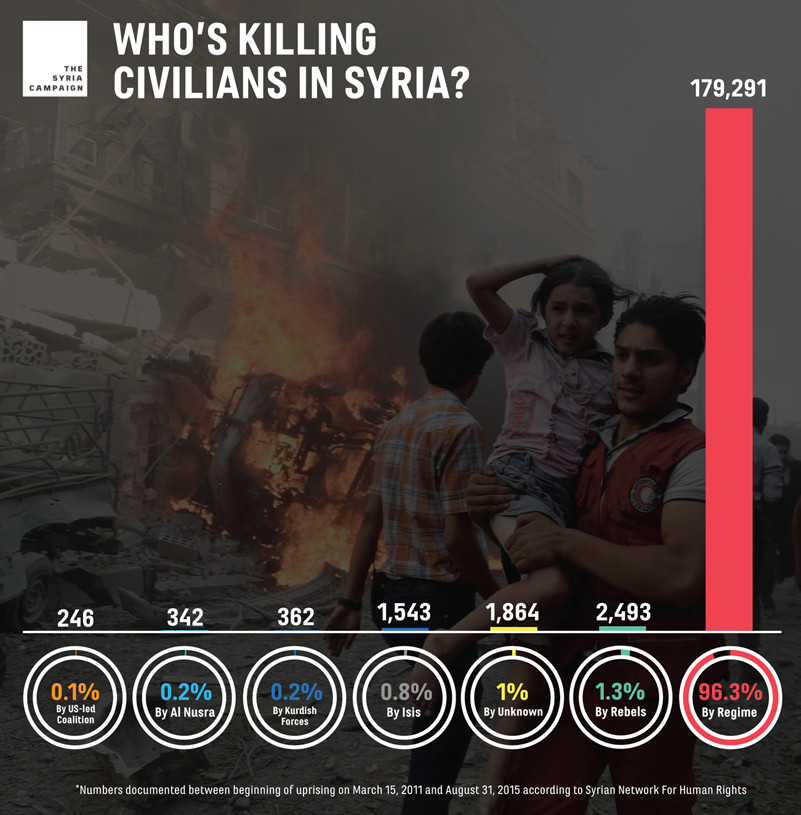
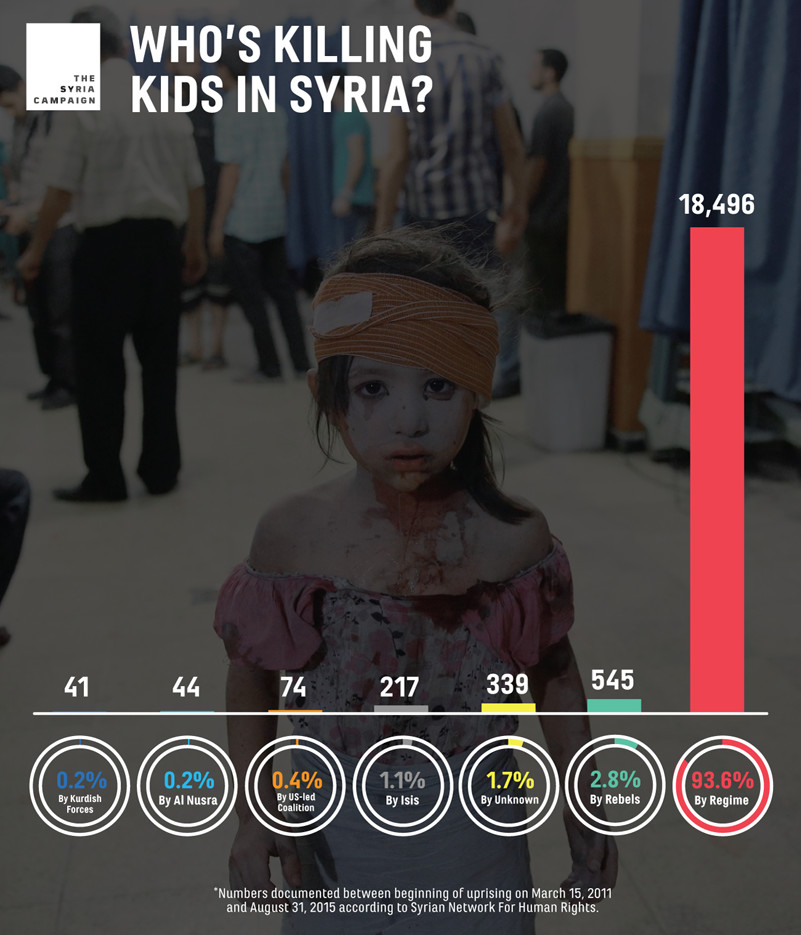
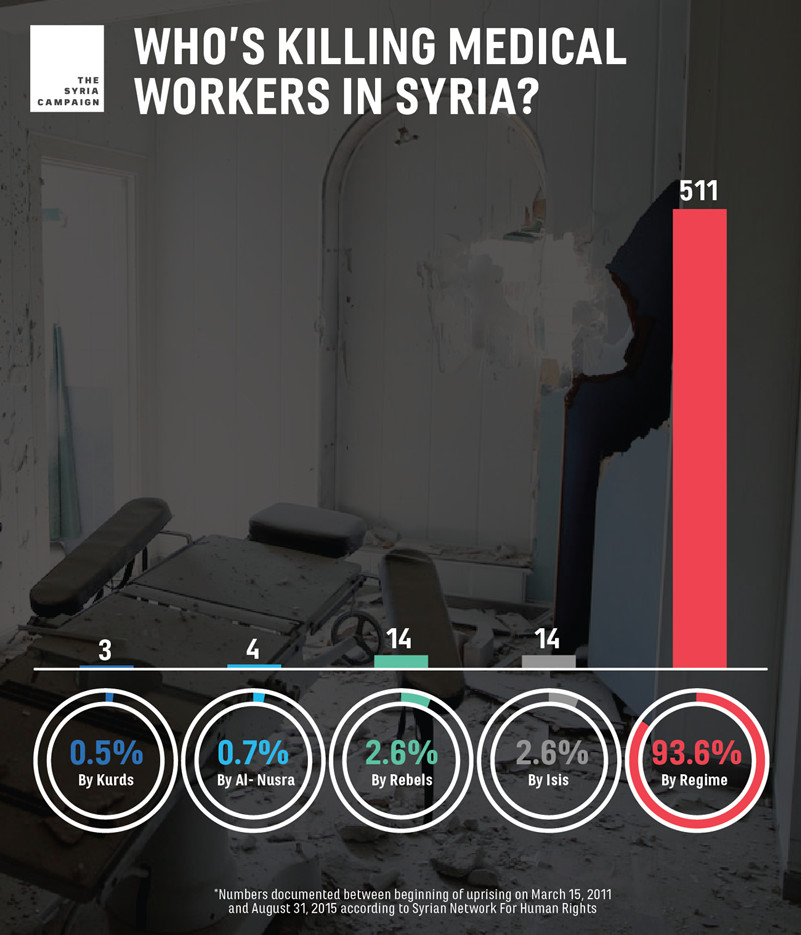
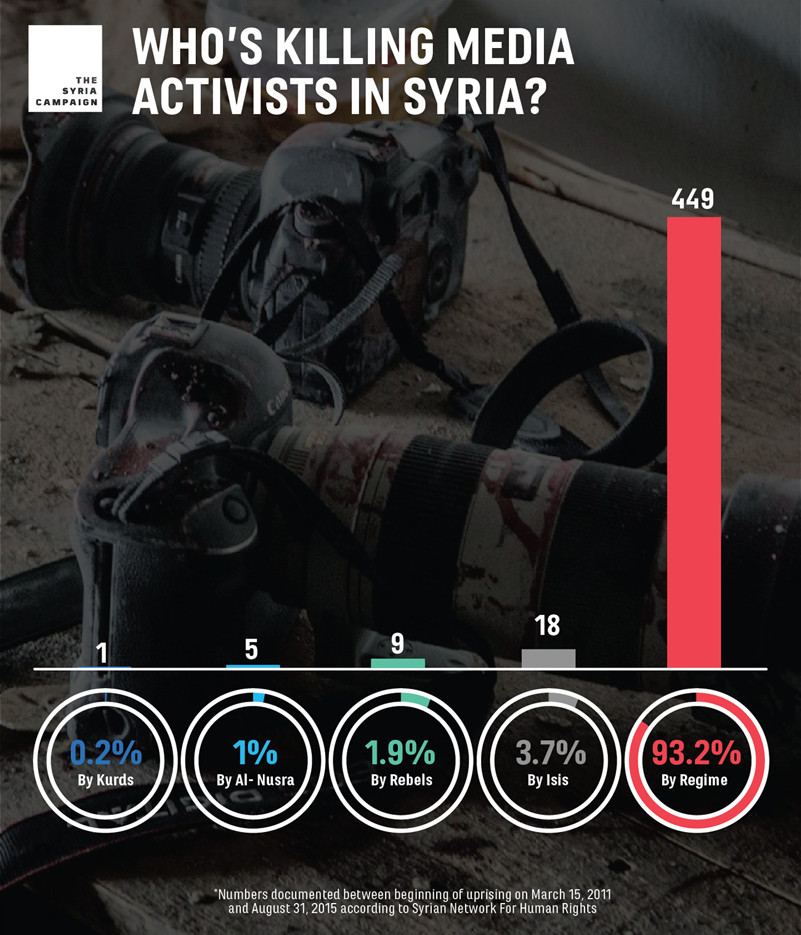
truth is different – and shocking. The
vast majority of Syrian civilians killed – more than 95% according to
human rights groups – have been killed by the regime of Bashar al-Assad.
“One
of the barrel bombs fell through a shaft in their home, filling the
ventilation with chlorine as it broke open. Their basement became a
makeshift gas chamber.” Dr Mohamed Tennari, Idlib province.
Children
“I
was captured by the police and put in prison for 22 days. I was
tortured and I saw children dying. I’ve got scars on my feet, chest and
back. There were hundreds of us in prison – I was in a big cell with the
other children. The youngest ones were nine or ten, they had been
captured. I was beaten up every day, and they used electricity too.” –
Moussa, 15, as told toSave The Children
Medical workers
“It
was during Ramadan, when people were fasting, and a plane shot a
missile at the hospital, killing a doctor, a nurse, and a baby in an
incubator.” Doctor in Kafrnabel, Idlib
“[The
regime] ordered me to torture my cousin. I did everything they asked. I
beat him with my hands, kicked him with my legs, beating him and
saying, ‘I’m sorry.” Inside Assad’s Hospitals of Terror -Vanity Fair
Why are these numbers surprising to so many people?
Lots
of people respond with astonishment when they see these figures, mostly
because they don’t fit with their existing picture of the conflict.
Some even say the numbers are lying. They’re not. While no monitoring
group claims to have perfect data since their methodology and
sources all differ, there appears to be agreement about the proportion
of civilians killed by the Assad regime. [1]
So why do so many of us have such a bad understanding of where the violence is coming from?
Part
of the answer may lie in how we hear about the conflict in Syria. The
media talks about it increasingly as a “civil war”, a phrase that
conjures up images of messy chaos, of various similarly-matched sides
fighting each other. Likewise, the United Nations and well-meaning NGOs
diligently criticise “all parties to the conflict” which promotes a
perception of equal sides – or some sort of balance.
But
there’s something else too. Part of the answer may lie in the
disproportionate obsession with Isis. Our news is full of stories of
Isis horror and brutality, but the larger scale state repression of the
Bashar al-Assad regime seems to slip by mostly unreported.
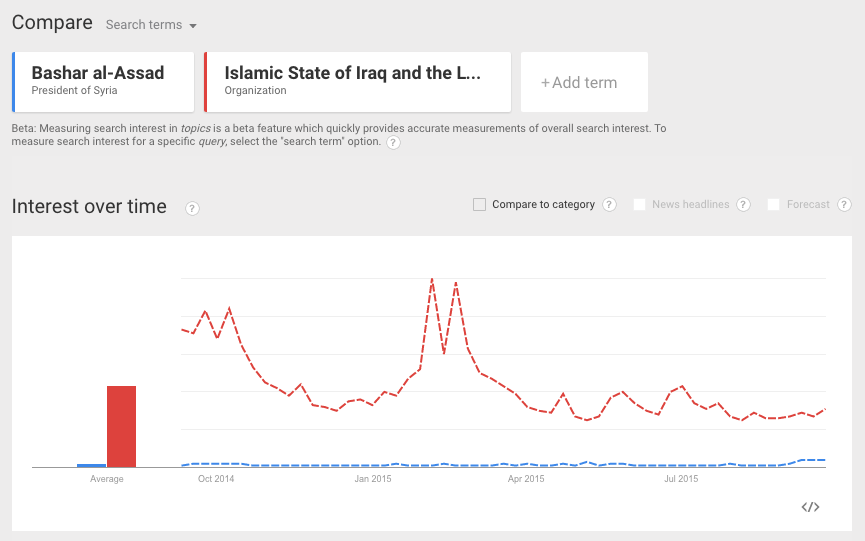
Have a look at Google Trends for news over the past year:
There was 43 times more interest in Isis than there was in Bashar al-Assad. And that’s taking in global internet users.
When we filter by United States only, we get:
Same goes for the UK, France and Germany.
Astonishing.
Together we have collectively airbrushed the biggest perpetrator of
human rights violations out of the the Syrian conflict – Bashar
al-Assad.
Why
has the world chosen to ignore Assad’s crimes? Is it because he claims
to be a secular leader? Is it because he is clean shaven and wears a
suit? Is it because we don’t realise that by ignoring these crimes by
the regime, we are becoming recruiting cheerleaders for Isis?
Whatever the reason, the obsession with Isis over Assad bears no relation to their respective levels of violence.
The implications of this skewed focus are serious.
And yet nobody, nobody, is doing anything to curtail the biggest killer in Syria by far – the Assad regime and its air war on civilians.
As the United Nations envoy to Syria, Staffan de Mistura said, it is “totally unacceptable that the Syrian airforce attacks its own territory in an indiscriminate way, killing its own citizens.
The use of barrel bombs must stop. All evidence shows that the
overwhelming majority of the civilian victims in the Syrian conflict
have been caused by the use of such indiscriminate aerial weapons.”
All efforts at stopping the violence in Syria will fail unless we understand where it is coming from. The story of the data is unarguable – if we want to stop the killing of civilians in Syria we have to address the Assad regime.
What can you do?
Arm those around you with the facts. Share this with your friends and family:
Then join the call for a ‘no-fly zone’ from
Syria’s impartial rescue workers the White Helmets who operate in
non-regime areas rescuing people from under the rubble of attacks.
Finally, if all those numbers about death are getting you down, here’s an inspiring story of hope:


 Shailah, the beautiful Mother of my First Grandson.


 The incredible moment journalist Peter Greste found out his...
 France urges Saudi Arabia to cancel death penalty for young...
 Psychiatrist disqualified for comparing lesbians to...