For decades, I have known and trusted Dr. Lorraine Day who cured her cancer all by herself by natural means!
https://www.bitchute.com/video/0p0uvXn21D2B/
VIRUSES DO NOT EXIST OUTSIDE THE BODY! DR. LORRAINE DAY
SAUDIS & MUSLIMS ACCEPT TO BE SODOMIZED WITH BIO WEAPON JABS!
Saudi Arabia says COVID-19 vaccination mandatory for Hajj 2021
Saudi health ministry said having a coronavirus vaccine is a must in order to participate in this year’s Hajj.
Hundreds
of Muslim pilgrims circumambulate the Kaaba, the cubic building at the
Grand Mosque, as they keep social distance to protect themselves from
the coronavirus [File: AP]
3 Mar 2021
Saudi
Arabia’s health ministry says only people who have been vaccinated
against COVID-19 will be allowed to attend the Hajj this year, Saudi
newspaper Okaz reported.
“The COVID-19 vaccine is mandatory for those willing to come to the
Hajj and will be one of the main conditions (for receiving a permit to
come),” Monday’s report said, citing a circular signed by the health
minister.
Saudi
Arabia takes pride in its guardianship of Islam’s holiest sites in
Mecca and Medina and its smooth organisation of the annual Hajj, which
has been marred in the past by deadly stampedes, fires and riots.
In 2020, the kingdom dramatically reduced the number of pilgrims
allowed to attend Hajj to about 1,000 Saudi citizens and residents of
the kingdom, in order to help prevent the spread of the coronavirus,
after barring Muslims abroad from the rite for the first time in modern
times.
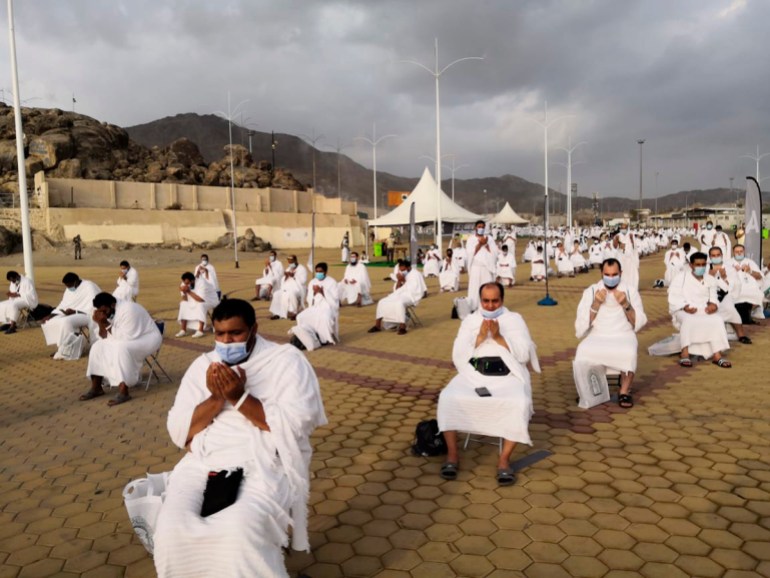
Physically
distanced Muslim pilgrims pray near the Mountain of Mercy in Arafat
during the annual Hajj pilgrimage near the holy city of Mecca, Saudi
Arabia on July 30, 2020 [File: AP]
Hajj, a once-in-a-lifetime duty for every able-bodied Muslim who can
afford it, is a major source of income for the Saudi government.
The congregation of millions of pilgrims from around the world can be
a major cause of coronavirus transmission. In the past, worshippers
have returned home with respiratory and other diseases.
In
the same circular, Saudi Minister of Health Dr Tawfiq al-Rabiah said
the government must be prepared to “secure the manpower required to
operate the health facilities in Mecca and Medina”.
These facilities will be stationed at entry points for pilgrims, he
said, in addition to a formation of a vaccination committee for pilgrims
within Saudi Arabia.
Saudi Arabia bars foreign pilgrims from Hajj due to COVID
Saudi Arabia says this year’s pilgrimage will be limited to 60,000 citizens and residents.
In
2020, the kingdom reduced the number of pilgrims allowed to attend the
pilgrimage to about 1,000 Saudi citizens and residents [AFP]
12 Jun 2021
No
foreign pilgrims will be allowed to perform the Hajj once again this
year after Saudi Arabia restricted the annual pilgrimage to citizens and
residents, and set a maximum of 60,000 pilgrims in response to the
coronavirus pandemic.
“Those wishing to perform the hajj must be free of chronic diseases
and be vaccinated” and between the ages of 18 and 65, the ministry said
in a statement on Saturday.
“In
light of what the whole world is witnessing with the coronavirus
pandemic … and the emergence of new variants, the relevant authorities
have continued to monitor the global health situation,” the statement
added.
Last year, the kingdom reduced the number of pilgrims
to about 1,000 Saudi citizens and residents to help prevent the spread
of the coronavirus, after barring Muslims abroad from the rite for the
first time in modern times.
Two-thirds were residents from among the 160 different nationalities
that would have normally been represented at the Hajj. One-third were
Saudi security personnel and medical staff. This year the pilgrimage is
expected to start in mid-July.
Hajj, a once-in-a-lifetime duty for every able-bodied Muslim who can afford it, is a major source of income for the Saudi government.
Before the pandemic enforced social distancing globally, some 2.5 million pilgrims
used to visit the holiest sites of Islam in Mecca and Medina for the
week-long Hajj, and the lesser, year-round Umrah pilgrimage, which
altogether earned the kingdom about $12bn a year, according to official
data.
The congregation of millions of pilgrims from around the world could be a major cause of coronavirus transmission.
Saudi Arabia has so far recorded more than 463,000 coronavirus infections, including 7,536 deaths.
The health ministry says it has administered more than 15 million
coronavirus vaccine doses, in a country with a population of about 34
million.
In
a relaxation of coronavirus curbs last October, Saudi Arabia opened the
Grand Mosque for prayers for the first time in seven months and
partially resumed the Umrah pilgrimage.
Indonesia cancels Hajj again amid concerns over COVID
Minister says the government will not allow Indonesians to travel for the Hajj ‘due to pandemic and for safety of the pilgrims’.
A
handout picture provided by the Saudi Ministry of Hajj and Umrah on
October 4, 2020, shows Saudis and foreign residents walking around the
Kaaba (Tawaf) in the Grand Mosque complex in the holy city of Mecca
[File: Saudi Ministry of Hajj and Umra via AFP]
3 Jun 2021
Indonesia
has cancelled the Hajj pilgrimage for people in the world’s largest
Muslim-majority nation for a second year in a row, due to concerns over
the COVID-19 pandemic.
For many Indonesians, the pilgrimage is a once-in-a-lifetime event, with an average wait time of 20 years due to a quota system.
“Due
to the pandemic and for the safety of the pilgrims, the government has
decided that this year it won’t allow Indonesian pilgrims to go again,”
the minister of religious affairs, Yaqut Cholil Qoumas, said in a
statement on Thursday.
Yaqut said Saudi Arabia had not opened access to the Hajj.
“It’s not just Indonesia … no countries have received quotas, because
the memorandum of understanding has not been signed,” he said.
Pilgrims who had paid Hajj fees will be pilgrims next year, he added.
Saudi
Arabia barred Muslims abroad from attending the Hajj in 2020 in a bid
to help prevent the spread of COVID-19. The move was the first such ban
in recent history.
Authorities also dramatically reduced the number of pilgrims allowed
to attend the rite to about 1,000 Saudi citizens and residents.
The Saudi health ministry said in March that it will allow people who have been vaccinated against COVID-19 to attend the Hajj this year.
But the Reuters news agency said in May that Saudi Arabia is again
considering banning overseas pilgrims because of worries about the
emergence of new coronavirus variants.
Two sources familiar with discussions told the agency that
authorities will only allow domestic pilgrims who have been vaccinated
or have recovered from COVID-19 at least six months before the
pilgrimage.
When are Hajj and Eid al-Adha 2021?
With
this year’s Muslim pilgrimage limited to 60,000 vaccinated citizens and
residents of Saudi Arabia, Al Jazeera rounds up the Muslim annual
pilgrimage.
The
Muslim annual pilgrimage known as the Hajj will start on July 18 with
Eid al-Adha being celebrated on July 20, according to Saudi Arabia’s
Supreme Court.
The Hajj is is one of the five pillars of Islam and a
once-in-a-lifetime duty for all able-bodied Muslims to perform if they
can afford it. Before the pandemic, some 2.5 million pilgrims would descend on Mecca for the five-day long Hajj.
Due
to the coronavirus pandemic, no foreign pilgrims will be allowed to
perform the Hajj once again this year after Saudi Arabia restricted
the annual pilgrimage to a maximum of 60,000 vaccinated citizens and
residents between the ages of 18 and 65. In 2020, only up to 10,000
Saudi citizens and residents were permitted to perform the annual
pilgrimage.
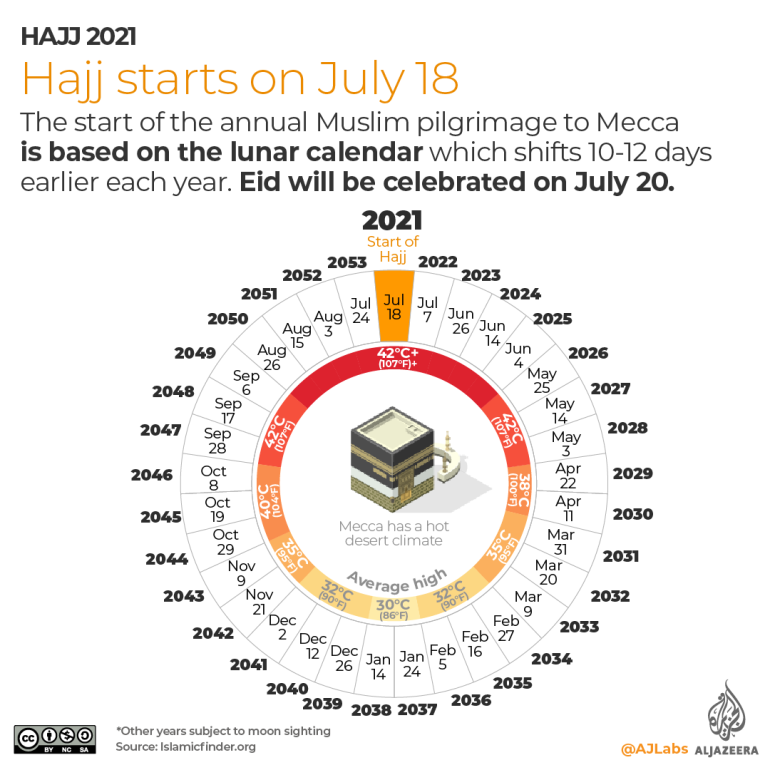
Hajj starts on July 18
Hajj falls on the 8th of Dhul al-Hijjah, the twelfth and final month
in the Islamic lunar calendar which shifts 10-12 days earlier each year.
This means that the next time Hajj will start after July 18 will be in
the year 2054 – 33 years from now.
Mecca is known for its hot desert climate with temperatures regularly
exceeding 42C (107F) in the summer months. It will be at least another
10 years until the average high temperatures will be below 38C (100F).
Eid begins July 20
Eid al-Adha or the Feast of Sacrifice, is celebrated on the third day
of Hajj and lasts for three days. This year Muslims worldwide will
celebrate Eid on 20-22 July. Eid al-Adha is the second major Muslim
festival after Eid al-Fitr, which marks the end of Ramadan, the month of
fasting.
How is Hajj performed?
For Muslims, the Hajj re-enacts the actions of the Prophet Muhammad
in his “farewell pilgrimage” in 632 AD which traces the footsteps of the
prophets Abraham and Ishmael through the Arabian desert. It is a
central pillar of the Islamic faith meant to cleanse followers of sin
and bring them closer to God.
We take a look at the step-by-step process in the infographic below.
Beqaraar
Hai Koi - Sung by Muhammad Rafi & Suraiya
From the
film Shama Parwana (1954)
Music by Husanlal Bhagatram
Lyrics by Majrooh Sultanpuri
N.B. This was before Hindustani cinema sold out to Satanic Forces!
Sarah, my beautiful Mona Lisa, my son's wife.
"Eid
al-Adha 2016 began in the evening of Saturday,
September 10 and ended in the evening of Sunday, September 11"
The Soviet Judaics (non Semites) sacrificed my First-Born son Olyeg of my Russian wife in 1968 in the name of Marxism and Communism!
Shailah, the beautiful Mother of my First Grandson. [Gif removed as per request - 2 July 2020]
JEWIPEDIA or WICKEDPEDIA
Eid al-Adha (Arabic: عيد الأضحى ʿīd al-aḍḥā
GOD OR NO GOD, THE REAL SPIRIT BEHIND
EID-AL-ADHA!
A Godsend
Background "Festival of the Sacrifice"), also called the "Sacrifice
Feast" or "Bakr-Eid", is the second of two Muslim
holidays celebrated worldwide each year, and considered the holier of the
two.
Like always, in order to justify
the why of a noble charitable practice, that is to feed the needy, some
religious leaders had to invent a story, a fable, which in this case is quite
stupid and insulting to God, if there is such a God outside our imagination
and belief system, but the concept and the beliefs in it are real and have
guided millions to this very day making them better human beings as far as
Islam is concerned.
The
Old Testament has depicted Abraham as very stupid and cowardly, and who
even sold his wife to the pharaoh like one sells a prostitute. The whole matter revolves around the
obligation of the believer in a Merciful God to feed the poor or the needy with
one third of their food, while at the same time sharing another third amongst
themselves, and the remaining with relatives, friends, neighbours and
travellers.
Muhammad, my unique son and his wife Shailah.
"In the Islamic lunar calendar, Eid al-Adha falls on the 10th
day of Dhu al-Hijjah and lasts for four days until the 13th
day.[4]
In the international (Gregorian) calendar, the dates vary from year
to year drifting approximately 11 days earlier each year.
My little Princess Layana
Eid al-Adha is the latter of the two Eid holidays, the former being Eid
al-Fitr. The word "Eid" has been used by "Semitic"
speaking people, like Arabic, Canaanite, Phoenician, Aramaic, Syriac, Hebrew,
etc., to mean CELEBRATION, and it "appears once in Al-Ma'ida,
the fifth sura of the Quran, with the meaning "solemn festival".[5]"
My
other two Princesses, Aïshah and Jumaymah. [Photo removed as per request - 2 July 2020]
"Eid al-Adha celebrations start at the same time as the
annual Hajj in Mecca.
The Arabic term "festival of the sacrifice", ʿīd
al-aḍḥā / ʿīd ul-aḍḥā is borrowed into Indo-Aryan languages such as Urdu, Hindi, Bengali,
Gujarati, and Austronesian languages such as Malay
and Indonesian (the last often spelling it as Aidil
Adha or Idul Adha). Another Arabic word for "sacrifice" is
Qurbani
(Arabic:
قربان.) The Semitic root Q-R-B (Hebrew ק-ר-ב)
means "to be close to someone/something"; other words from the root include qarov, "close", and qerovim, "relatives."
The senses of root meaning "to offer" suggest that the act of
offering brings one closer to the receiver of the offering (here, God). The
same stem is found in Hebrew and for example in the Akkadian
language noun aqribtu "act of offering.
Eid al-Kabir, an Arabic term meaning "the Greater Eid" (the
"Lesser Eid" being Eid al-Fitr),[8] is
used in Yemen, Syria, and North Africa (Morocco, Algeria, Tunisia, Libya, and
Egypt). The term was borrowed directly into French as Aïd el-Kebir.
Translations of "Big Eid" or "Greater Eid" are used in
Pashto (لوی اختر Loy Axtar), Kashmiri
(Baed Eid), Urdu and Hindi (Baṛī Īd), Tamil
(Peru Nāl, "Great Day") and Malayalam (Bali
Perunnal, "Great Day of Sacrifice"). Albanian,
however, uses Bajram(i) i vogël or "the Lesser Eid" (as
opposed to Bajram i Madh, the "Greater Eid", for Eid al-Fitr)
as an alternative reference to Eid al-Adha.[citation needed]
The festival is also called "Bakr-Eid" in Urdu and Hindustani languages (بقر عید, baqr `īd),[9][better source needed]
stemming from the Arabic word al-Baqara meaning "The Cow", although some have
wrongly attributed it to the Urdu and Hindustani word bakrī, meaning
"goat", because of the tradition of sacrificing a goat in South Asia
on this festival. This term is also borrowed into other Indian languages, such
as Tamil Bakr `Īd Peru Nāl.[citation needed] Some names refer to the fact that the holiday occurs after the culmination
of the annual Hajj.
Such names are used in Malaysian and Indonesian (Hari Raya Haji
"Hajj celebration day",[10][11][12]Lebaran Haji, Lebaran Kaji. When this was not yet an official
feast in the Philippines, this was how it was called in Mindanao and
other predominantly Muslim areas. When it became a legal holiday in 2009, it
became officially known as Eid al-Adha. Some also reference it with local
language names like Kapistahan ng Pagsasakripisyo in Tagalog.
In Tamil it is called (Hajji Peru Nāl).[citation needed]
[Photograph removed as per request - 2 July 2020]
It's also known as Id ul Baqarah in Egypt, Saudi Arabia and in the
Middle East, as Eid è Qurbon in Iran, Kurban Bayramı ("the
Holiday of Sacrifice") in Turkey, Baqarah Eid in India, Pakistan
and Trinidad, Eid el-Kebir in Morocco, Tfaska Tamoqqart in the Berber
language of Jerba, Iduladha or Qurban in Singapore,
Malaysia, Indonesia and the Philippines, Qurbani Eid in Bangladesh, Bakr-Id
("Goat Eid") in parts of Pakistan and India and Tabaski or Tobaski
in Senegal and West Africa[10][11][12][13]
(most probably borrowed from the Serer
language — an ancient Serer religious festival[14][15][16][17][source needs
translation]), Babbar Sallah in Hausa
language and ciida gawraca in Somali.[citation needed] Eid al-Adha
has had other names outside the Muslim world. The name is often simply
translated into the local language, such as English Feast of the Sacrifice,
German Opferfest, Dutch Offerfeest, RomanianSărbătoarea Sacrificiului, and HungarianÁldozati ünnep. In Spanish it
is known as Fiesta del Cordero[18]
or Fiesta del Borrego[19]
(both meaning "festival of the lamb")."
SACRIFICE MY SON?
Possessed by the Devil and the love of money, my French wife threatened to kill our 2 year old son (SACRIFICE HIM TO SATAN!) and then kill herself!
I had to call the Police who sent a Brigadier to visit them and make sure they were both safe because I was working in Paris, some 70 kilometres away!
She almost succeeded by slowly killing us, and stealing our home, businesses, funds, and poisoning our lives thanks to her new "partner" Christopher Dean Harrington, a "Jehovah Witness" in 1997!
The other myth that Abraham would
allow himself to be bullied by his childless, aged and menopaused wife Sarah and
abandon his wife Hagar and first-son "baby" Ishmael (Isma'il) to die
in the desert of Arabia is pathetic. Other
myths were added to that pathetic story!
This totally fabricated story "is
known as the Akedah in Judaism (Binding of Isaac) and
originates in the Tora,
the first book of Moses (Genesis, Ch. 22). Their corrupted religion allowed them tp
practice human sacrifice.
See Holy Qur'ân, Sura 37 (As-Saaffat),
Ayat 100–112
In
short, there was NO HUMAN SACRIFICE, but just a sacrifice of personal wealth
for the needy!
Believers, men, women, children
and babies, wherever and whenever possible attend a congregation of
believers inside a building or in a large field (an Eidgah) to
celebrate the Eid act of worship, and perform certain rituals according to Muslim
Traditions, not necessarily according to Islam, and differing from country to
country, and culture to culture.
"The scholars differed concerning the ruling on Eid
prayers. There are three scholarly points of view:
That Eid
prayer is Fard Kifaya (communal obligation). This is the view of Abu
Hanifa.
That it
is Wajib on all Muslim men (a duty for each Muslim and is
obligatory for men); those who do not do it without an excuse are
considered sinners. This is the view of Ahmad ibn Hanbal, and was also narrated from
Abu Hanifa."
A variety of incantations are
practiced across the Muslim lands. The
most common is:
Allāhu akbar, Allāhu akbar
اللهأكبراللهأكبر
lā ilāha illā-Allāh
لاإلهإلاالله
Wallāhu akbar, Allāhu akbar
واللهأكبراللهأكبر
walillāhi l-ḥamdu
وللهالحمد
Allah is the Greatest, Allah is the Greatest!
There is no god but Allah!
Allah is the Greatest, Allah is the Greatest!
And to Allah goes all praise!
In order to provide the required food,
it was the Tradition, even before perfected Islam to sacrifice animals. This sacrifice is called Corban in the Bible,
and aḍḥiya in Arabic (Arabic:
أضحية). It is also known by
the Perso-Arabic term qurbāni. What is disgusting and utterly revolting (IF
TRUE!) is the slaughter of "more
than 100 million animals in only two days of Eid. In Pakistan alone nearly ten
million animals are slaughtered on Eid days costing over US$3 billion.[31]"
What I personally know to be true since my teenager years is that during the
Annual Pilgrimage or HAJJ, millions of animals are cruelly slaughtered and
bulldozed into the ground by the CIA-SAUDIS (Crypto-Jews) (in OCCUPIED ARABIA) and by the stupid,
fanatical and barbaric Pilgrims.