Showing posts with label REVERTS. Show all posts

Sunday, 9 March 2014

Choosing Islam - Reverts Tell Their Stories

Choosing Islam

Reverts Tell Their Stories

Uploaded on 15 Jan 2008

 
These are inspiring personal stories of Americans choosing Islam. Let this video help you rekindle the faith in your heart!

Their stories are amazing and different, but their ultimate destination is the same: Islam. Islam is the fastest growing religion in the world and America is no exception to this phenomena. This video helps to demystify this amazing trend.

This is a collection of interviews with Americans of different racial, ethnic and religious backgrounds who explain why they have chosen to become Muslim, embracing the faith of over 1 billion humans worldwide.

Some of these people are:

Rafael Narbaez a former pastor with the Jehovah's Witnesses. Narbaez was born and raised in Texas and he is from a Hispanic family. While he grew up as a Catholic he later became a Jehovah's Witness. Initially, he started reading the Quran to get a better understanding of the Bible, but instead, it helped him understand Islam. He later embraced the faith.

Dr. Muhammad Eckhaus was born in New York to a Jewish family. He was impressed by the generosity and humility of Muslims, which brought him closer to Islam and finally he accepted the faith.

Yusuf Islam, the former Cat Stevens was a world famous rock star in the 1970s. Islam was from a Greek Orthodox family and experimented with many different religions seeking inner peace. One day, he received a copy of the Quran as a birthday gift from his brother David. After reading the Quran, Islam decided to leave his life in the entertainment industry for life as a Muslim, since it was this faith which gave him the inner peace he was seeking.

Br. Omar Abdur Rahman, a lawyer, first read the highly controversial anti-Islamic book Satanic Verses. Then, he decided to read the Quran to get the other side of the story. He eventually became a Muslim.

Sister Aisha Mustafa is editor of Chicago-based newspaper The Muslim Journal. She compared different religions and then decided that Islam was the only choice for her.

"Choosing Islam: one man's story" was an article written by Abdal Hayy Moore, a revert to Islam, a writer and a poet. He managed a theater company in California when he was introduced to Islam. His article got published in several publications. Moore says that one day a person came to him and told him that he had accepted Islam after reading Moore's article.


This video also features some historical footage of Imam W. D. Muhammad and Malcolm Shabazz or popularly known as Malcolm X. After performing Hajj, Malcolm realized that Islam is a universal religion and it is only Islam, which can solve the race problem in America.

This is an excellent Dawa tool. Hearing the experiences of those who have chosen Islam as their way of life as Americans on this continent is sure to pique the curiosity of others who still see Islam as a "foreign" faith.
  • Category


     WOMEN EMBRACING ISLAM

     JOSHUA EVANS

     DR LAWRENCE BROWN

    DR GERALD DIRKS

    HUSSEIN YEE

    YVONNE RIDLEY

    And THOUSANDS OTHERS!

    Alhamdulillah!

    Who Guards The Most Sacred Site In Christendom? Two Muslims

    on March 29 2013 11:55 PM
     
    Church of Holy Sepulchre During a Holy Fire Ceremony in Jerusalem's Old City
    Shown is the Church of Holy Sepulchre during a Holy Fire ceremony in Jerusalem's Old City. Reuters/Steve Crisp

    JERUSALEM -- Every Christian knows the holiest places in Christendom are in Jerusalem. The holiest of all, the Church of the Holy Sepulchre, was erected in 325, over the site where it is believed Jesus was crucified, buried and rose from the dead.

    Yet, few know that it is a Muslim who opens and closes the only door to this holiest of Christian sites.

    In fact, it's two Muslims: one man from the Joudeh family and another man from the Nuseibeh family, two Jerusalem Palestinian clans who have been the custodians of the entrance to the Holy Sepulchre since the 12th century.

    Every morning, at 4:30, Adeeb Joudeh travels from his apartment outside the walls of the Old City to bring the cast-iron key to the church, just as his father and his forebears did before him.

    Once there, he entrusts the key -- looking like a 12-inch (30-centimeter) long iron wedge -- to Wajeeh Nuseibeh, who knocks at the gate to call the priests and the pilgrims who spend the night praying inside. From inside the church, a wooden ladder is passed through a porthole to help him unlock the upper part of the enormous door.

    Then, he unlocks the lower one before handing the precious key back to Joudeh. The ritual is reversed every evening at 7:30, after hundreds of tourists and pilgrims have left the church.
    During holidays, such as Holy Week, which culminates Sunday with the Christian Easter, the elaborate opening and closing ceremonies take place several times a day.

    Why the elaborate ritual? As often happens in Jerusalem, a city holy to several peoples and religions, there are different versions to explain why two Muslim families hold the key to the holiest site in Christendom.

    “After the Muslim conquest in 637, the Caliph Omar guaranteed the Archbishop Sophronius that the Christian places of worship would be protected and so entrusted the custodianship to the Nuseibehs, a family who originated in Medina and had had relations with the Prophet Muhammad,” said Nuseibeh, a retired 63-year old electrician, while waiting in a nearby cafe to carry out his duties at the Holy Sepulchre.

    “It happened again in 1187, after Saladin ended the Crusader Kingdom of Jerusalem. He chose our family again to look after the peace between the different Eastern and Western Christian confessions, which were at odds over control of the Sepulchre," he said with a gentle smile, sitting next to his son, Obadah.

    To this day, coexistence among the several Christian churches sharing the Holy Sepulchre is a delicate one. Catholic, Greek, Armenian, Coptic, Syriac, and Ethiopian Orthodox monks have resorted to fists more than once to defend their respective denomination’s rights and privileges in the church, as defined in an decree by the Ottoman Empire, known as the Status Quo of 1853.
    Such impious brawls between clergy proved Saladin’s prescience 1,000 years ago, when the sultan sealed the second front gate of the church and entrusted control of the remaining entrance to neutral custodians.

    The Nuseibehs claim that the Joudehs entered this story only in the 16th century, after the Ottoman Turks gained control of Palestine and decided to charge a second family with the responsibility of guarding the key.

    “Yes, we share the responsibility with the Joudehs, and sometimes we argue, as happens in a family,” Nuseibeh said.

    Each Maundy Thursday since the end of the 19th century, the two Muslim families give the key to the Holy Sepulchre to the local Franciscan friars, for as long as it takes to walk to the church in a procession and to open the door after the morning liturgies. When those are completed, the friars return the key to the families.

    This ceremony, which confirms in practice the validity of the Muslim families’ custodianship, is repeated with the Greek and Armenian communities, on Orthodox Good Friday and Holy Saturday, respectively.

    “Right now, I have in my hands the keys to Christendom’s heart. This is a very important moment for us,” said the Rev. Artemio Vitores, the Spanish Franciscan who is the vicar Custodian of the Holy Land, during the Maundy Thursday procession.

    “For centuries, Christian pilgrims were denied entry to the church, or had to pay huge sums to pray on the Sepulchre,” he said, all while holding the key.

    At the head of the procession, Vitores was flanked on one side by Wajeeh Nusseibeh, his son Obadah and two cousins, all of whom were equally compensated by the friars for their services with the symbolic sum of $60.

    On Vitores’ other side were Adeeb Joudeh, wearing an impeccable dark gray suit, and his 19-year-old son Jawad.

    For about 20 minutes, Joudeh ceded control of the only existing key to the Holy Sepulchre. While there is another key, it is broken and no longer used. The functioning key is normally kept in a small office attached to the church and is guarded by an employee of the Joudeh family.
    “This key has seen Saladin and every generation of my family since 1187. To me, it’s an honor to be in charge of the holiest of Christian places," Joudeh said, while walking the cobblestoned alley leading to the Holy Sepulchre.

    He insisted on showing on his smartphone what he claimed are 165 official decrees confirming the Joudeh family’s role as custodian of the church over the centuries.

    “My ancestor who was given the keys was a sheik, a highly respected person, who was not supposed to perform physical labor, such as climbing the ladder to open the gate,” Joudeh explained. “That’s why the Nuseibehs were called in to perform this duty. Unfortunately, they feel still ashamed of being just the doorkeepers.”

    At the end of the procession, the key was welcomed by cheerful pilgrims waiting in front of the church.

    For a few minutes, everybody stared at the solemn opening of the gate before rushing in.
    Moments later, Adeeb Joudeh walked home with his son, as did Wajeeh Nuseibeh. They will come back here, time and again, at the gate of the Holy Sepulchre: two Muslims, coming in peace to bear the key to the heart of Christianity.


Saturday, 25 January 2014

ISLAM BLOOMS IN PANAMA AND ABDULLAH HAKIM QUICK

Islam Blooms in Panama

(5 votes, average 5.00 out of 5)
OnIslam & News Agencies
Thursday, 23 January 2014 00:00

The establishment of Al Haqq mosque by two native women has drew criticism from some members of the Panamanian Muslim community. 
CAIRO – The number of Muslim reverts in the Central American republic of Panama has been growing rapidly over the past years, laying the basis of their community in the country’s first native mosque.
“This is the first time we have a place for Panamanians,” Bianca Chanis, a Panamanian Muslim revert told Religion Dispatches  magazine on Wednesday, January 22, while describing the nation's first worshipping house for Muslims.

“And everyone’s welcome.”

For years, a growing number of Muslim reverts in the Central American republic has faced challenges towards establishing their first mosque.

Their dream came true last November after the community opened Al Haqq mosque, nine years after the first call was made in 2005 by Josefina Bell-Munajj and Khadijah Jackson.

The mosque, though not the first Muslim worshipping house, was praised as catering to the native Panamanians reverting to Islam.

Moreover, the mosque would serve as a haven for people interested in getting more information about Islam or spearheading interfaith initiatives in the community.

The mosque was not the only challenge facing the growing Muslim community in Panama.

Muslim parents have been struggling to offer Islamic education to their children.

“We try to teach him Islam, but school confuses him," said Anais Gobea, a Panamanian mother who reverted to Islam four months ago, about her son who attends a public school and get confused with the Catholic education.

Campaigning for mosque was not the only effort spearheaded by Bell-Munajj and Khadijah Jackson.

In 2011, they started religious classes for a small group of women in a room they borrowed from a local Muslim dentist. They started with ten people in 2011 and increased to thirty by the next year.

"We started feeling the urgency to get a new space because we were bursting out the room,” Bell-Munajj, Al haqq co-founder, said.

Islam reached Panama in the mid-16th century through the African Muslim slaves who came to work in mines at that time.

Muslims from Lebanon, Palestine, India, Pakistan, and West Indian countries started to influx to Panama in the twentieth century.

Cultural Differences
The diverse Muslim community in Panama has brought different practices of Islam to the Central American country.

The establishment of Al Haqq mosque by two native women has drew criticism from some members of the Panamanian Muslim community.

"Islamic culture says that when men are around, women should support them," said Abdul Kabir Malik, one of the first Panamanian Islamic leaders in the country who reverted to Islam in the 1970s.

A different opinion was shared by Walid Handauz, an Arab leader in the Centro Islamico Cultural mosque, who asserted that Islam has united different cultures in Panama.

“We try to gather everyone in one basic road,” Handauz claimed.

The Number of Panamanians joining Islam is rapidly growing, according to Ahmad Bhattay, a leader at Panama City’s Jama Mosque.

The diverse Muslim community in Panama comprises Muslims from different origins and cultures.

The thriving community started recently to draw native followers besides the Muslim immigrants who are mainly from Lebanon, Palestine, Indian and Pakistan.

Bhattay claims that more than 500 Muslims attend the Friday prayer at Jama Mosque, besides two or three new converts attending the mosque every week.

He refuted allegations about discrimination inside the Muslim community in Panama.

“Maybe ten, fifteen, twenty years ago, there was,” Bhattay said, adding that people are open to attend events at whichever mosque they prefer.

According to the latest tallies released in 2009, Muslims make less than 1% of Panama's population with 24,000 Muslims who are concentrated in Panama City and Colón.

Most Muslims in Panama live in the major cities of Panama City and Colón, with smaller numbers in other provincial cities.
Related Links:
Why-Islam Expands in Mexico
Austria's Thriving Islam
Islam Thrives in Igbo Land
Islam Blooms in Japan
Latino Muslim Ambassadors

Published on 30 Dec 2013
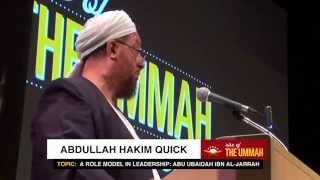
A Role Model in Leadership for Muslim Youth - Abu Ubaidah ibn al-Jarrah radiya Allahu anhu - Abdullah Hakim Quick
____________________

ABOUT THE SPEAKER -

Dr Abdullah Hakim Quick is a historian, social activist and religious leader of African and Native American descent. He has travelled to over 58 countries doing research and delivering lectures to various communities. His qualification in Islamic Studies comes from a BA from the Islamic University of Madinah, Saudi Arabia and his history background is shaped by an MA and PhD from the History Department of the University of Toronto, Canada.

Dr Quick has served as a special advisor to the Toronto Board of Education, the Ontario Science Centre and the Royal Ontario Museum as well as a regular columnist in the religion page of one of Canada's leading daily newspapers, The Toronto Star. He has initiated and developed special classes for the hearing impaired of Canada and the underprivileged of Southern Africa. He has been a guest lecturer at York University (Toronto), McGill University, the University of the Western Cape (South Africa) in the Departments of History, Women's Studies, Geography and Middle-East Islamic Studies and African Studies as well as member of the Chaplains Association of the University of Toronto. He has also developed and facilitated workshops and training sessions for diverse organizations such as Children's Aid Society, Metropolitan Toronto School Boards, Family Service Association of Metro Toronto, Canadian Museums Association, Canadian Institute for International Affairs, the Canadian Churches Forum for Global Ministries, Elementary Teachers Association of York Region, Metro Toronto School for the Deaf, the Scarborough Public Library Board, and Al Wagah, Muslim Deaf Society of Cape Town.

For over ten years, Dr Quick was Director of the Islamic Social Services and Resources Association, one of Canada's first recognized Islamic social service agencies. There he counseled hundreds people from all walks of life and various religions and developed one of Canada's first Muslim food banks. He has often spoken out against "gay bashing" and vigilantism

He has participated in interviews as an expert on African History and Islamic issues with major Canadian, Caribbean and South African media organizations, such as CBC TV, City TV, CFRB, Channel 47 (Canada) and the SABC, 702 Cape Talk, Voice of the Cape, Radio 786, Channel Islam, Radio Ansar (Durban, South Africa).

He has a number of scholarly presentations and publications but his recent focus has been on documentary films such as Timbuktu, the Empire of Knowledge, Untold Ethiopia and Reflections from the Western Sunrise (Quick Answers) that all aired on national television in South Africa.

Previously, Dr Abdullah was the Director of the Discover Islam Centre of Cape Town , South Africa and a special advisor to the Ministry of Islamic Affairs of the Kingdom of Bahrain.

Presently, Shaykh Abdullah is residing in Toronto, Canada and is the Head of the History Department of Al Maghrib Institute and the Director of Outreach for the Canadian Council of Imams.

About 746 results
  1. A Role Model in Leadership for Muslim Youth - Abdullah Hakim Quick

    A Role Model in Leadership for Muslim Youth - Abu Ubaidah ibn al-Jarrah radiyaAllahu anhu - Abdullah Hakim Quick. ABOUT ...
    • HD
  2. Establishing Islam in Africa (Dr Abdullah Hakim Quick)

    Dr Abdullah Hakim Quick is an international Scholar, Speaker, Da'wah worker and historian. He has travelled to, more than 51 ...
  3. How Youth Can Contribute - Abdullah Hakim Quick

    This is chapter 12. Watch the full lecture at: http://youtu.be/PaITeNHFX9Y Buy the DVD, CD or Download at ...
  4. Making Islamic Education Relevant For Today - By Abdullah Hakim Quick

    Download this lecture from iTunes: http://www.IslamOnDemand.com/166iod.html We are the original producer of this video.
  5. Islamic Roots in the West by Dr. Abdullah Hakim Quick

    • by iioc
    • 2 years ago
    • 1,533 views
    A lecture by Dr. Abdullah Hakim Quick on Jan. 27, 2011 at IIOC in Anaheim, California, titled: "The Hidden Truth: Islamic Roots in ...
    • HD
  6. Islam And Different Spheres of Life (Abdullah Hakim Quick)

    Dr Abdullah Hakim Quick is an international Scholar, Speaker, Da'wah worker and historian. He has travelled to, more than 51
  7. Knowledge of the Heart by Dr. Abdullah Hakim Quick

    Sheikh Abdullah Hakim explaining some of the saying of the Prophet Muhammad (PBUH) (hadith) and talking about the youth ...
  8. Abuse & Signs of The Last Hour - Dr. Abdullah Hakim Quick | Khutbah Dec.14, 2012

    Dr Abdullah Hakim Quick is an international Scholar, Speaker, Da'wah worker, and historian. He has travelled to, more than 51 ...
  9. The Youth and Our Responsibility - Shaykh Abdullah Hakim Quick

    Dr Abdullah Hakim Quick is an international Scholar, Speaker, Da'wah worker, and historian. He has travelled to, more than 51
  10. Deeper Roots: African-Muslims Black History, By: Abdullah Hakim Quick

    Deeper Roots: African-Muslims Black History By: Dr. Abdullah Hakim Quick It was a great evening at the Abu Bakr Islamic Centre, ...
  11. Empowering the Muslims of Today [Full Lecture] ll Sheikh Abdullah Hakim Quick [2013]

    Dr Abdullah Hakim Quick is an international Scholar, Speaker, Da'wah worker, and historian. He has travelled to, more than 51 ...
  12. We Need Social Service Agencies - Abdullah Hakim Quick

    This is chapter 8. Watch the full lecture at: http://youtu.be/eKf66CitvwE Buy the DVD, CD or Download at ...
  13. Waking the Lazy Muslim - Dr. Abdullah Hakim Quick

    Dr Abdullah Hakim Quick is an international Scholar, Speaker, Da'wah worker, and historian. He has travelled to, more than 51 ...
  14. Quick Answers documentary

    This biographical documentary profiles Sheikh Abdullah Hakim Quick, who lives and currently runs the Discover Islam Centre in ...
  15. Virtues of Ramadan (Episode 1~10) - Dr. Abdullah Hakim Quick

    Dr Abdullah Hakim Quick is an international Scholar, Speaker, Da'wah worker, and historian. He has travelled to, more than 51 ...
  16. The Day of Judgement is Near by Shaykh Abdul Hakim Quick

    Dr Abdullah Hakim Quick is an international Scholar, Speaker, Da'wah worker, and historian. He has travelled to, more than 51 ...
WESTERN GODLESS CULTURE PRODUCES THIS!

Shoplifting gran, 76, went on four-year crime spree 'because she was bored of being old'

June Humphreys, 76, travelled using her free bus pass, pocketing hundreds of pounds of goods by swiping them off shelves and hiding them in her shopping trolley


A shoplifting great-grandmother clocked up a criminal record ‘like a teenage heroin addict’ because she was ‘bored of being old’, a court heard.

June Humphreys, 76, travelled using her free bus pass, pocketing hundreds of pounds of goods by swiping them off shelves and hiding them in her shopping trolley.

The pensioner stole clothes, alcohol and even a breast pump during a four-year crime wave because she needed to ‘fill her time’ while living alone.

Humphreys, who has seven children, had shoplifting convictions between 2011 and 2014 and even travelled 100 miles from her home to carry out offences.

On Monday, Humphreys, from Crewe, Cheshire, was hauled before North Staffordshire Justice Centre where she admitted a string of thefts.

After arriving for court pushing her trolley Humphreys pleaded guilty to stealing from four shops in Hanley, Stoke-on-Trent, Staffs, on the same day. 

But she walked free after being sentenced to one month in prison suspended for a year and was warned if she shoplifts again she will be sent to jail.


The mother-of-seven went on a four-year crime wave because she was 'bored' of living along. (SWNS) JPs were told Humphreys had previous convictions for shop theft in 2011, 2012 and 2013 and January this year.

Her probation officer Darren Vernon told the court: 'She has travelled around Staffordshire and Cheshire on public transport and committed offences.

'She knows what she is doing is wrong, she says she is bored and needs to fill her time.

'The main reason for her doing this is boredom. She lives alone.

'She has seven children but the only one she has contact with lives above her.

'She has acquired the record of a heroin addict in his late teens.'

The court heard she nicked confectionery worth £2 from Iceland, baby clothes worth £69 from BHS, baby clothes worth £24.98 from B & M, and a breast pump from Boots.

Humphreys, from Crewe, Cheshire, also admitted stealing alcohol, coffee and confectionery worth £30.42 from Aldi and two pairs of boots worth £94.50 on December 18.
The court heard Humphreys' offending took her on a journey of over 100 miles as far as Leek, Macclesfield, Stafford, Whitchurch and Stoke-on-Trent.


Prosecutor Giles Rowden said: 'The defendant has convictions for shop theft in 2011, 2012 and 2013 and on January 14 this year she was fined for shop theft at West Cheshire Magistrates.'
The court recommended she was given one last chance after hearing the pensioner was being treated for breast cancer and also suffered from osteoarthritis.


Andrew Bennett, defending, added: 'My client does not want to go to prison. She wants to stop doing this. She wants to stop stealing from shops.'

JPs revoked a community order which had previously been imposed for theft but ordered her to pay £45 costs and an £80 victim surcharge.